In any material processing plant, crushing the rock is only the first step. To create a sellable product that meets strict construction or industrial standards, that crushed material must be accurately sorted. This is where the vibrating screen becomes the most critical piece of equipment in your workflow. Serving as the “cash register” of a crushing plant, it dictates the final quality, size, and grade of your aggregates.
Whether you are setting up a new quarry or looking to optimize an existing production line, understanding how these machines operate is essential for maximizing your plant’s efficiency and profitability.
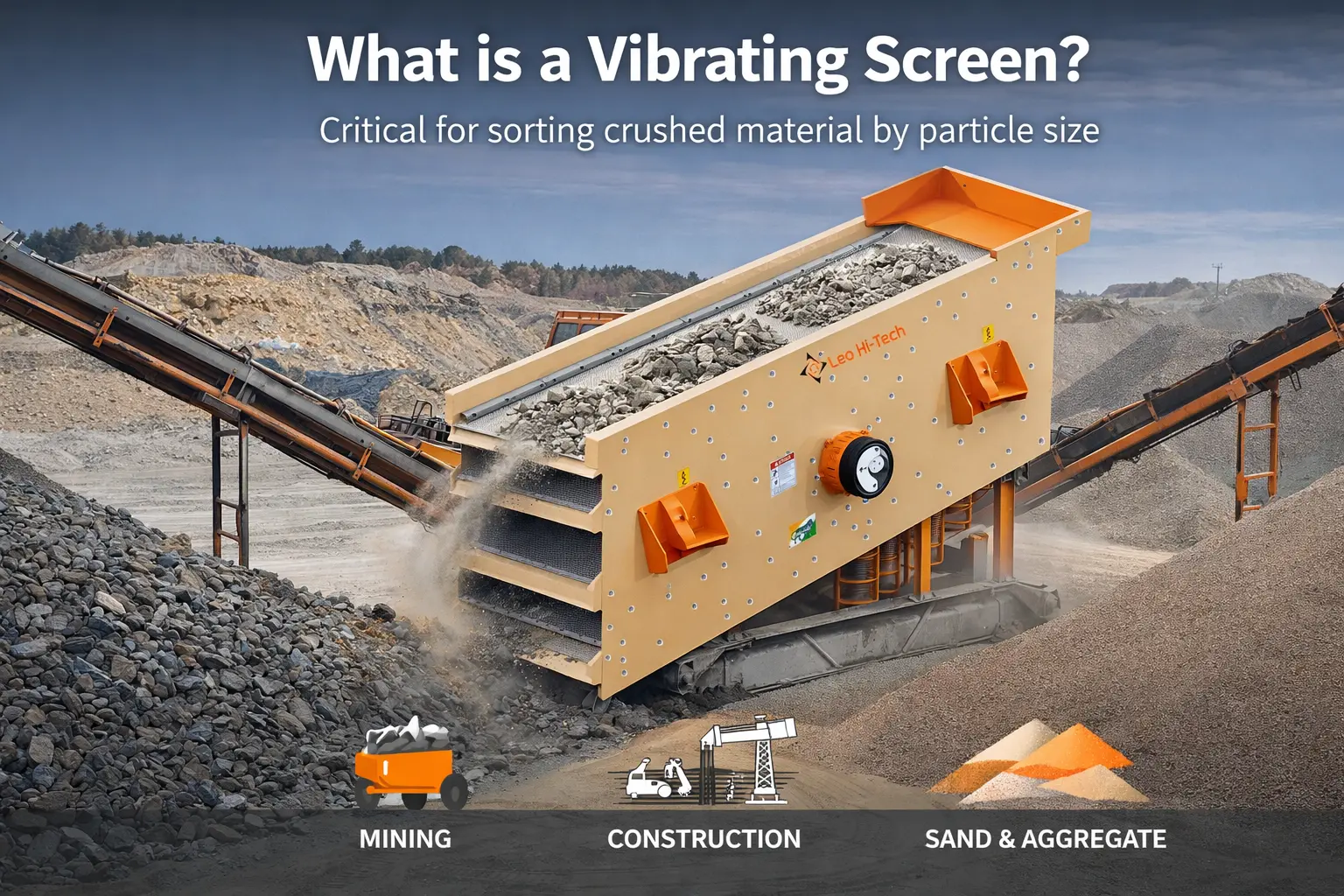
What is a Vibrating Screen?
A vibrating screen is a heavy-duty industrial sizing machine that utilizes mechanical vibrations to separate mixed bulk materials into distinct, uniform grades based on particle size. The performance of a vibrating screen is primarily controlled by vibration amplitude, frequency, and screen inclination, which together determine screening efficiency and throughput.
At its core, it is used for separating materials by size, ensuring that oversized rocks are sent back to the crusher while correctly sized products are stockpiled for sale. Because of their versatility, these machines are foundational to several major industries:
-
Mining
For grading raw ores before and after the milling process.
-
Construction
For preparing road base, asphalt aggregates, and concrete mix materials.
-
Sand & aggregate
For classifying manufactured sand (M-sand) and natural river gravel.
Depending on the region and specific application, you might also hear this equipment referred to by various synonyms, including a screening machine, vibratory screen, or simply aggregate screening equipment.
How Does a Vibrating Screen Work?
The working principle of a vibrating screen is highly effective yet mechanically straightforward.
The machine is powered by a vibrator assembly (usually an eccentric shaft or twin vibrating motors) that generates continuous kinetic energy. Material is continuously fed onto a screening surface that is riddled with specifically sized holes. As the machine vibrates, the material bed is agitated and thrown forward.
This bouncing action stratification causes the smaller particles to work their way to the bottom of the material bed and fall through the mesh gaps. The larger, oversized particles remain on top of the mesh and travel off the end of the screen to be re-processed or stockpiled.
Types of Vibrating Screens
Different materials and plant setups require different vibrational motions. Here are the primary types used in the industry today:
-
Circular Vibrating Screen
The most common type in aggregate plants. These screens are typically installed at a downward incline (usually 15 to 20 degrees). They use a single eccentric shaft to create a circular motion, relying on gravity to help tumble heavy rock down the screen deck.
-
Linear Vibrating Screen
These screens are typically installed horizontally or with a slight incline depending on the application. And utilize two counter-rotating vibrating motors to create a straight-line, linear motion that forcefully throws the material forward. They are highly precise and are often used for finer materials, washing plants, or dewatering sand.
-
Elliptical Vibrating Screen
Combining the best of both worlds, these screens generate an oval (elliptical) motion. This aggressive action is excellent for high-capacity screening and reduces sticky or wet materials from clogging (blinding) the mesh.
-
Multi-deck Vibrating Screen
Instead of a single flat surface, these machines feature multiple layers of screen mesh stacked on top of one another (commonly 2, 3, or 4 decks). The top deck has the largest holes, and the bottom deck has the smallest, allowing a single machine to sort three to five different product sizes simultaneously.
Key Components of a Vibrating Screen
A rugged and reliable vibratory screen relies on several heavy-duty components working in unison:
-
Screen mesh / deck
The actual sorting surface. This can be made of woven steel wire mesh, perforated steel plates, or highly durable Polyurethane (PU) panels.
-
Vibrating motor
The driving force of the machine. It provides the necessary amplitude and frequency to keep the material moving and separating efficiently.
-
Springs
Heavy-duty steel coil springs or rubber buffers sit between the screen body and the base frame. They absorb the massive vibrational forces, protecting the plant structure from damage.
-
Frame
The rigid side plates and crossbeams that hold the screen mesh and vibrating assembly together. It must be engineered to withstand constant stress.
-
Feed box
The entry point where bulk material is deposited onto the screen. A well-designed feed box distributes the rock evenly across the entire width of the deck, preventing uneven wear and tear.
Applications of Vibrating Screen
Because sizing is a universal requirement in material handling, vibratory screens are deployed across a wide range of sectors:
-
Stone crushing plants
Acting as the final sorting stage to produce standard aggregate sizes like 10mm, 20mm, and 40mm for concrete and asphalt.
-
Mining operations
Sizing precious metals, coal, and iron ore to optimize the efficiency of downstream grinding mills.
-
Sand & gravel separation
Washing and grading river sand or M-sand to remove unwanted clay and silt dust.
-
Recycling industries
Processing construction and demolition (C&D) waste to separate reusable crushed concrete and asphalt from dirt and debris.
Advantages of Vibrating Screen
Investing in a high-quality aggregate screening equipment provides several operational benefits:
-
High efficiency screening
Capable of processing hundreds of tons per hour, preventing bottlenecks in high-yield plants.
-
Accurate particle separation
Ensures that your final products consistently meet strict industry grading specifications, keeping your buyers happy.
-
Low maintenance
Built with robust mechanical components such as bearings, shafts, and vibration mechanisms, designed for durability and long operational life.
-
Continuous operation
Engineered with heavy-duty steel and robust vibration dampening, they are designed to run 24/7 in the harshest environments.
How to Choose the Right Vibrating Screen
Choosing the right vibrating screen comes down to understanding your specific production needs. You must evaluate the maximum feed size coming from your crushers, your required capacity in Tons Per Hour (TPH), and the exact final product sizes you need to produce (which dictates the number of decks). Additionally, factoring in whether your material is dry, wet, or sticky will help you decide between a circular, linear, or elliptical motion machine. By aligning the machine’s specifications with your material characteristics, you ensure maximum yield and minimal downtime.
FAQs
What is a vibrating screen used for?
A vibrating screen is used in industrial plants to separate mixed bulk materials like crushed stone, ore, sand, or coal into specific, uniform sizes by passing them over vibrating decks with sized holes.
What is the difference between a linear and circular vibrating screen?
A circular vibrating screen sits on a downward slant and uses a circular bouncing motion alongside gravity to move heavy materials. A linear vibrating screen sits flat horizontally and uses dual motors to forcefully throw the material forward in a straight line, making it better for precise sizing and wet materials.
How much does a vibrating screen cost?
The price varies widely based on size, capacity, and the number of decks. In India, a small single-deck screen might start around ₹2 Lakhs to ₹4 Lakhs, while a heavy-duty, multi-deck screening station for a high-capacity plant can range from ₹10 Lakhs to ₹25+ Lakhs.
Which vibrating screen is best for sand?
A linear vibrating screen is generally best for sand, especially when equipped with a high-frequency vibration system or used as a dewatering screen. This motion is highly effective at separating fine dust from the sand and handling wet processing without clogging.