In the demanding worlds of aggregate production and mining, efficiency and reliability are everything. When processing mid-hard to very hard abrasive materials, a standard jaw crusher simply won’t cut it for the secondary or tertiary stages. Enter the cone crusher, a powerhouse of compression crushing. For mid-to-large-scale operations, investing in a robust machine like the cone crusher (typically denoting a mm cone diameter) is a strategic move to maximize throughput and achieve excellent product shape.
Whether you are upgrading an old plant or building a new one from scratch, understanding the technology behind these machines is crucial. This guide breaks down everything you need to know about cone crushers, their variations, and what to look for before making a purchase.
What is a Cone Crusher?
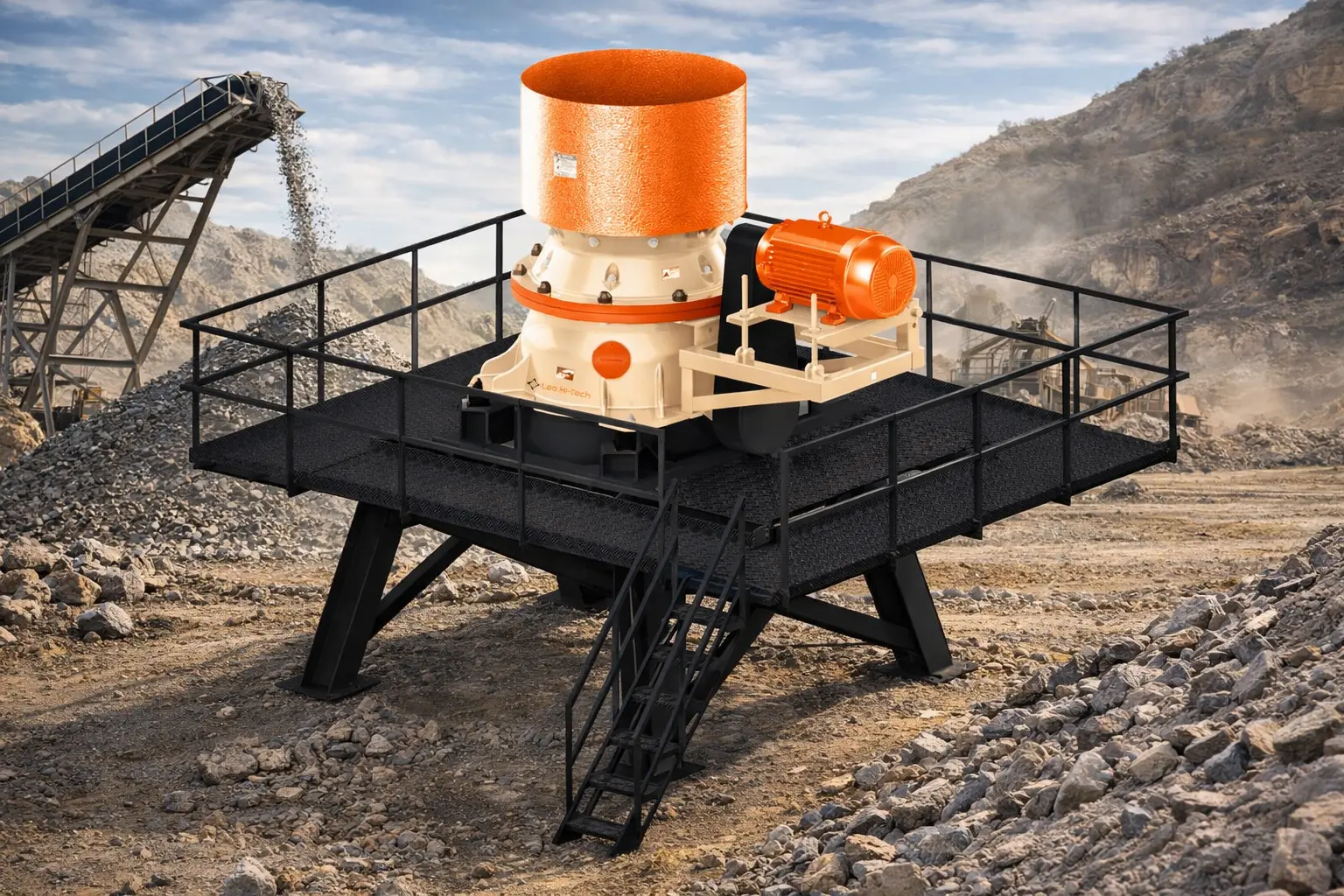
A cone crusher is a type of compression crusher used extensively in the metallurgical, construction, road building, and chemical industries. It works by squeezing the feed material between a moving piece of steel (the mantle) and a stationary piece of steel (the bowl liner or concave).
How a Cone Crusher Works
A cone crusher operates on the principle of continuous compression within a confined crushing chamber. At its core, a mantle performs a gyratory motion inside a stationary concave (bowl liner), driven by an eccentric mechanism. As material enters from the top, it is compressed between these surfaces and progressively reduced in size as it moves downward.
This crushing action continues until the material becomes small enough to pass through the bottom opening, known as the Closed Side Setting (CSS), which determines the final product size.
For optimal performance, cone crushers are typically operated under choke feed conditions, where the chamber remains full. This promotes interparticle (rock-on-rock) crushing, improving product shape, increasing efficiency, and reducing liner wear.
Performance is influenced by factors such as eccentric throw, chamber design, and CSS, allowing operators to control output size and capacity.
Types of Cone Crusher
Choosing the right type of crusher depends heavily on the stage of crushing and the desired final product.
-
Standard Cone Crusher
Standard cone crushers are primarily used for secondary crushing. Standard cone crushers have a larger feed opening and a coarser crushing cavity, allowing them to accept larger feed sizes.
-
Short Head Cone Crusher
Short head cone crushers are designed for tertiary or quaternary crushing. They have a longer parallel crushing zone and a finer cavity design, optimized for producing smaller and more uniform output.
-
Hydraulic Cone Crusher
This is the modern standard for high-efficiency plants. Hydraulic cone crushers use hydraulic cylinders to adjust the crusher setting and provide safety against uncrushable materials. They offer advanced automation, making it incredibly easy to adjust the machine’s parameters on the fly without manual labor.
-
Spring Cone Crusher
The spring cone crusher is the traditional, mechanical predecessor to the hydraulic models. It uses heavy-duty springs located around the base of the machine to hold the upper frame down. If uncrushable material (tramp iron) enters the chamber, the springs compress to let it pass. While older technology, they are still widely used due to their simplicity and lower initial cost.
Top Advantages of the Cone Crusher
-
Superior Product Shape
Cone crushers achieve interparticle (rock-on-rock) crushing when operated under choke feed conditions, improving product shape. This naturally creates highly cubical aggregates, which are strictly required for high-strength concrete and asphalt applications.
-
High Uptime & Easy Maintenance
Modern cone crushers, particularly hydraulic models, are designed with top-down serviceability. Wear parts like the mantle and bowl liner can be replaced relatively quickly, minimizing plant downtime.
-
Automated Tramp Relief
When an uncrushable object like a digger tooth enters the chamber, the crusher needs to protect itself. Both spring and hydraulic systems feature a tramp relief mechanism that momentarily opens the crushing chamber to let the metal pass, preventing catastrophic internal damage.
-
Adjustable Stroke Lengths
Many advanced cone crushers allow operators to adjust the eccentric stroke (the “throw” of the mantle). A larger stroke increases capacity, while a shorter stroke allows for finer, more precise crushing.
-
Versatility
By simply changing the crushing cavity profiles (from extra-coarse to extra-fine liners), a single cone crusher base can be adapted to serve as either a secondary or tertiary crusher as your plant’s needs evolve.
What are the Ideal Applications for the cone crushers?
-
Hard Rock Quarrying
Cone crushers excel at processing highly abrasive and hard rocks like granite, basalt, quartzite, and river gravel. Their compression-style crushing means the wear parts last significantly longer than the blow bars in an impact crusher.
-
Mining Operations
In metal mining (iron ore, copper, gold), cone crushers are the go-to machines for reducing the ore to a manageable size before it is sent to ball mills or grinding circuits. Models like the cone crusher are favored for their high capacity in these continuous operations.
-
M-Sand Plants
Manufactured Sand (M-Sand) requires a very specific, fine input. Cone crushers acting as the tertiary stage prepare the perfect feed size for Vertical Shaft Impactors (VSIs) to create high-quality, graded sand.
Key Specifications to Evaluate Before Buying Cone Crusher
-
Production Capacity
Measured in Tons Per Hour (TPH), this dictates how much material the machine can process. Ensure the capacity aligns with your primary crusher to avoid plant bottlenecks.
-
Motor Power
Usually measured in kilowatts (kW) or horsepower (HP). A higher motor power indicates the crusher’s ability to handle harder rocks and higher volumes without stalling.
-
Maximum Feed Size
This is the absolute largest piece of rock the machine can accept without jamming the feed hopper. Standard crushers accept larger feed, while short head models require smaller, pre-crushed feed.
-
Closed Side Setting (CSS) Range
The CSS is the narrowest distance between the mantle and the bowl liner at the bottom of the chamber. This setting determines the maximum size of your final product. Check the crusher’s minimum and maximum CSS range to ensure it can produce your required aggregate sizes.
Conclusion
A cone crusher is the beating heart of any serious aggregate or mining operation. Whether you opt for a reliable traditional spring model or a highly automated hydraulic cone crusher , choosing the right machine comes down to understanding your feed material, desired output, and required capacity. By carefully evaluating the specifications and matching them to your exact application, you can ensure a highly profitable and efficient crushing plant.
FAQs
What is the price of a cone crusher machine?
Prices vary drastically based on capacity, brand, and technology. A small, basic spring cone crusher might start around ₹15–20 Lakhs, while a high-capacity, fully automated hydraulic cone crusher (like a series) can cost upwards of ₹1 Crore to ₹3 Crores or more.
What is the difference between a CG cone crusher and a standard spring cone crusher?
A standard spring cone crusher uses mechanical springs for safety and manual threading to adjust the size. A CG (single-cylinder hydraulic) cone crusher uses a hydraulic system to automatically adjust the size and safely release tramp iron, resulting in much higher automation and easier maintenance.
What does CSS mean in a cone crusher?
CSS stands for Closed Side Setting. It is the smallest distance between the moving mantle and the stationary bowl liner at the bottom of the crushing chamber. The CSS dictates the maximum size of the crushed rock exiting the machine.
How does the floating shaft design work?
Found in single-cylinder hydraulic crushers, a heavy-duty hydraulic piston sits at the bottom of the machine and literally supports (or “floats”) the main shaft. By pumping hydraulic oil in or out, the piston raises or lowers the shaft to adjust the CSS seamlessly.
What materials can a CG cone crusher process?
CG cone crushers are built for the toughest jobs. They can easily process highly abrasive materials including granite, basalt, diabase, river cobble, iron ore, and copper ore.
What does TPH mean in cone crusher?
TPH stands for Tons Per Hour. It is the standard metric used to measure the production capacity and throughput of heavy crushing and screening equipment.