In the aggregate, mining, and material processing industries, evaluating equipment comes down to one fundamental question: how much material can this machine process, and how fast? Whether you are sizing a new primary jaw crusher or auditing an existing closed-circuit plant, understanding capacity metrics is the difference between a highly profitable operation and a logistical bottleneck.
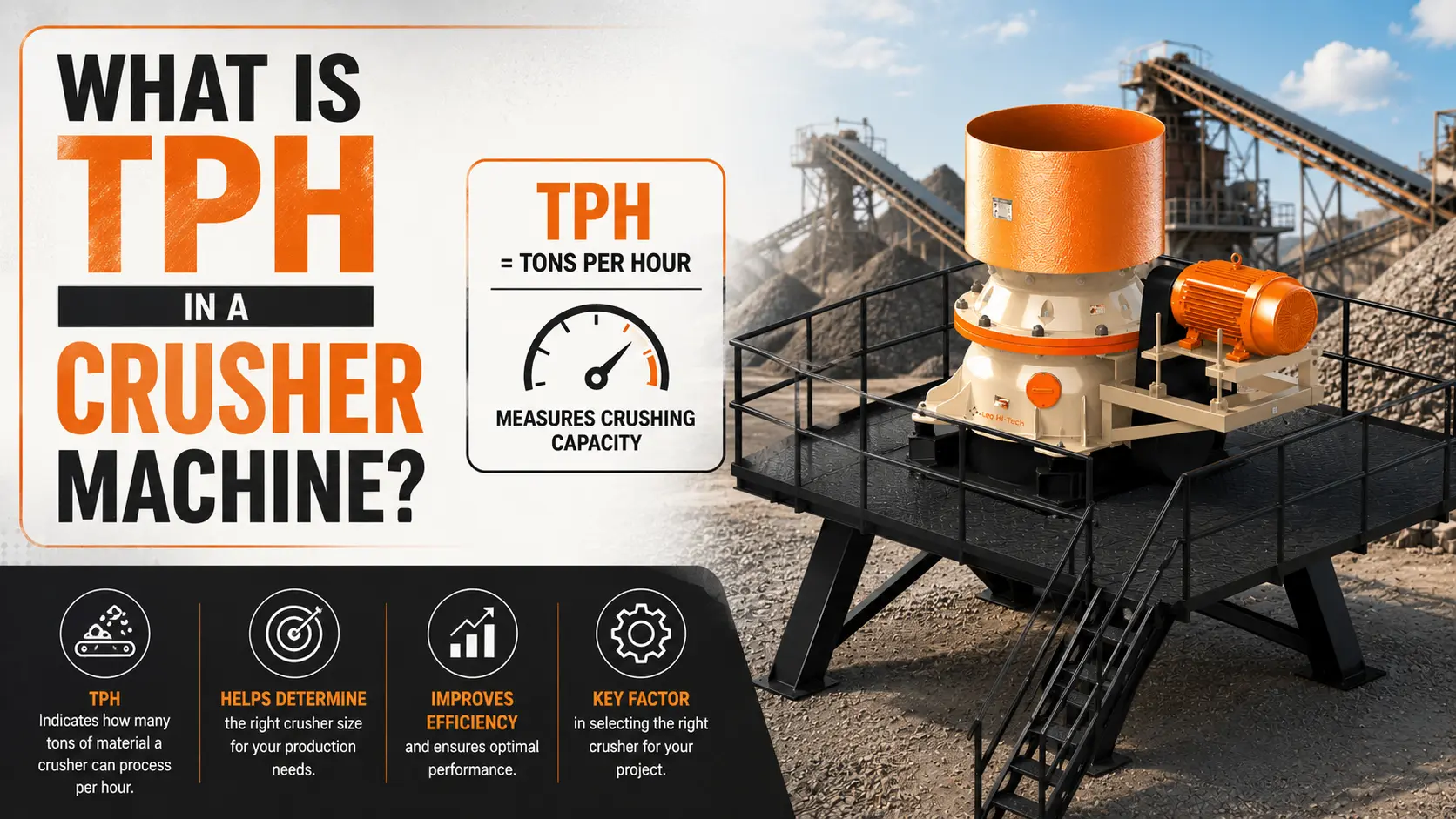
What does TPH mean in a crusher? In the aggregate and mining industry, TPH stands for Tons Per Hour. It is the standard metric used to measure the production capacity and throughput of a crusher machine. For example, a 200 TPH jaw crusher processes 200 tons of raw rock or ore every sixty minutes under optimal conditions.
While the definition is straightforward, calculating, achieving, and maintaining your target TPH is highly complex. The number printed on a manufacturer’s brochure rarely matches the real-world output of a dusty, high-vibration quarry site.
This comprehensive guide breaks down exactly what TPH means, the operational variables that influence it, how to measure it accurately, and how to optimize your crushing plant to achieve maximum throughput.
Why TPH is the Most Critical Metric for Plant Design
Tons Per Hour is the heartbeat of your crushing plant. It is the foundational metric that dictates your total revenue, your operating expenses, and the structural design of your entire processing facility. Plant engineers do not look at a crusher in isolation; they look at the TPH to ensure systemic harmony across all equipment.
When designing an aggregate plant, the TPH dictates:
- Conveyor Belt Sizing: The width, speed, and motor power of your conveyor belts must be perfectly calibrated to match the TPH of the crusher feeding them. If a 300 TPH crusher discharges onto a belt rated for 200 TPH, material will spill over the sides, damaging equipment and requiring manual cleanup.
- Vibrating Screen Dimensions: A crusher only reduces the rock; the vibrating screen sorts it. The screen deck area must be large enough to process the crusher’s TPH. An undersized screen will result in “carryover,” where perfectly sized material is accidentally sent back into the crusher, wasting energy and reducing overall plant efficiency.
- Secondary and Tertiary Crusher Selection: If your primary jaw crusher operates at 400 TPH, your secondary cone or impact crushers must be sized to handle that exact volume (minus any fines removed by a pre-screen). Mismatched TPH ratings lead to severe bottlenecks.
- Return on Investment (ROI): Ultimately, aggregate is sold by the ton. Your plant’s TPH directly calculates your daily, monthly, and annual revenue projections, which justifies the initial capital expenditure of the machinery.
Key Factors That Directly Affect a Crusher’s Actual TPH
It is a common misconception that a crusher operates at a fixed capacity. A machine rated for 250 TPH might only produce 150 TPH if the operational variables are poorly managed.
Here are the primary factors that cause fluctuations in your crusher’s throughput:
| Operating Factor | How It Impacts TPH (Capacity) |
| Feed Size & Distribution | Feeding rocks that are too large causes bridging, halting production. A consistent, well-graded feed maximizes throughput and minimizes voids in the crushing chamber. |
| Rock Hardness & Density | Harder materials (like granite or basalt) take longer to crush and require more kinetic energy, naturally lowering the effective TPH compared to softer rocks (like limestone). |
| Closed Side Setting (CSS) | The CSS dictates the final output size at the bottom of the crushing chamber. Tightening the CSS to produce smaller material restricts the discharge opening, significantly lowering the TPH. |
| Moisture Content | Wet, sticky, or clay-heavy materials can clump together, clogging the crushing chamber and blinding the vibrating screens, which severely reduces overall capacity. |
| Choke Feeding | For cone crushers, maintaining a full chamber (choke feeding) actually increases efficiency and TPH by promoting rock-on-rock crushing and maintaining uniform wear. |
Expanding on the Variables
- The Impact of Closed Side Setting (CSS) The Closed Side Setting is the narrowest distance between the crushing surfaces (such as the jaw plates or the cone mantle and bowl liner) at the bottom of the stroke. If you open the CSS to produce 100mm aggregate, the material falls through the chamber quickly, resulting in a high TPH. If you tighten the CSS to produce 40mm aggregate, the machine must perform more work on the rock, keeping it in the chamber longer. This restricted discharge opening heavily reduces your TPH.
- Rock Characteristics (The Bond Work Index) Throughput is physically limited by what you are crushing. The Bond Work Index is a measure of the energy required to crush a specific material. High-compressive-strength materials resist fracturing. If you feed high-strength quartzite into a machine calibrated for limestone, the motor will draw excess amperage, and the feed rate must be slowed down to prevent stalling, thereby dropping the TPH.
- Feed Presentation How the rock enters the crusher is just as important as the rock itself. A surge-heavy feed—where the crusher is empty one minute and buried under a massive load the next—destroys efficiency. Utilizing a variable-speed vibrating grizzly feeder ensures a consistent, metered flow of material, which is critical for hitting your target TPH.
How is TPH Measured on a Job Site?
You cannot optimize what you do not measure. Modern aggregate plants rely on precision instrumentation to track TPH in real-time, allowing operators to make immediate adjustments.
Inline Belt Scales: The industry standard for measuring TPH is the inline belt scale. These are installed directly onto the main discharge conveyor belts. They utilize two primary components:
- Load Cells: These heavily calibrated sensors measure the downward physical weight of the crushed rock resting on a specific section of the belt.
- Speed Sensors: These track exactly how fast the conveyor belt is moving (usually in meters per second).
A specialized integrator computer multiplies the weight of the material by the speed of the belt to calculate a highly accurate, real-time TPH reading. This data is usually beamed to the central control cabin, allowing the plant manager to speed up or slow down the raw feed.
Manual Spot Checking: In smaller operations or when calibrating equipment, operators may use the “cut-and-weigh” manual method. This involves safely stopping a loaded conveyor belt, scraping off a specific length of material (e.g., one meter), weighing it, and applying a mathematical formula based on the belt’s operating speed to estimate the 60-minute throughput.
Nameplate Capacity vs. Operational Capacity
When purchasing a crusher, procurement officers must understand the critical difference between theoretical data and real-world application.
- Nameplate Capacity (Theoretical TPH): This is the TPH printed in the manufacturer’s brochure. It is determined under perfectly controlled conditions using dry, medium-hard rock with a perfectly continuous feed and an optimal Closed Side Setting.
- Operational Capacity (Actual TPH): This is what the machine will actually produce in your quarry. Real-world conditions involve wet weather, operator pauses, oversized boulders, and minor mechanical adjustments.
Industry best practice dictates applying a Utilization Factor when designing a plant. A well-run plant typically operates at an 80% to 85% utilization rate. Therefore, if you need to reliably produce 200 tons of aggregate every hour, you should not buy a machine with a nameplate capacity of 200 TPH. You should target a machine rated for at least 240 to 250 TPH to absorb the inevitable real-world inefficiencies.
TPH vs. TPD vs. TPY: Scaling Your Production
While TPH is the metric used for real-time equipment sizing, you will often encounter related acronyms when discussing plant economics and long-term quarry planning.
- TPD (Tons Per Day): This is used to calculate daily revenue and schedule trucking logistics. If a 200 TPH plant runs for a single 8-hour shift at 85% efficiency, the operational TPD is roughly 1,360 tons.
- TPY (Tons Per Year): This macro-metric is used for long-term financial modeling, environmental permitting, and calculating the lifespan of a quarry. It accounts for seasonal shutdowns, major maintenance overhauls, and weekend closures.
How to Optimize and Increase Your Existing TPH
If your current crushing circuit is underperforming its nameplate capacity, replacing the crusher is not always the first step. Often, the bottleneck lies elsewhere in the circuit.
- Remove the Fines Early: Utilize a vibrating grizzly feeder to scalp out dirt, clay, and naturally undersized rock before it enters the primary jaw crusher. Forcing a crusher to process material that is already at the desired size wastes chamber space and drastically lowers your effective TPH.
- Optimize Vibrating Screens: If your screens are blinded (plugged with wet material) or undersized, they will send correctly sized rock back through the return conveyor. Upgrading to high-frequency vibrating screens ensures maximum open area, preventing this “recirculating load” from stealing capacity from raw, uncrushed rock.
- Implement Automation: Modern plant automation systems link the belt scale data to the variable frequency drive (VFD) of the primary feeder. The computer will automatically speed up or slow down the raw feed to keep the crusher’s motor operating at exactly 95% of its maximum amperage, squeezing every possible ton out of the machine safely.
Frequently Asked Questions
-
How do you calculate the TPH of a conveyor belt?
You calculate conveyor TPH using inline belt scales equipped with load cells and speed sensors. They measure the material’s physical weight over a specific belt section and multiply it by the belt’s speed to provide highly accurate, real-time tons per hour data.
-
Is a higher TPH always better?
No, a higher TPH is only beneficial if your entire plant can handle it. If your primary crusher’s TPH exceeds the capacity of your conveyors, vibrating screens, or secondary crushers, it will cause severe bottlenecks, material spills, and costly mechanical failures.
-
What is a typical TPH for a primary jaw crusher?
A typical primary jaw crusher in a mid-sized aggregate plant processes between 150 and 400 TPH. However, heavy-duty mining jaw crushers can easily exceed 1,000 TPH depending on the feed opening size and the electric motor’s kilowatt rating.
-
Does the type of crusher affect the TPH?
Yes, different crushers handle throughput differently. Cone crushers often yield a higher TPH for secondary crushing when choke-fed, while jaw crushers are designed for bulky primary reduction. Impact crushers provide excellent reduction ratios, but their TPH drops with highly abrasive rock.
-
How can I increase the TPH of my existing crushing plant?
To increase actual TPH, optimize your upstream feed with variable frequency drives, ensure cone crushers are choke-fed, strictly maintain the Closed Side Setting (CSS), and upgrade to high-frequency vibrating screens to prevent recirculating loads from clogging the circuit.