Walk into almost any hard-rock quarry or mine and you will find a cone crusher somewhere between the primary jaw crusher and the screens. It rarely gets the attention of the big primary machine, yet it does much of the work that decides whether your final product meets specification. Understanding how a cone crusher works helps you set it correctly, feed it properly, and spot problems before they turn into downtime.
This guide explains the working principle of a cone crusher in plain language, walks through the crushing cycle step by step, and covers the settings and operating conditions that control capacity and product quality. A labelled diagram is included to help you follow the motion.
What Is a Cone Crusher?
A cone crusher is a compression crusher used mainly for secondary, tertiary, and quaternary crushing of medium-hard to very hard and abrasive rock. Typical materials include granite, basalt, quartzite, river gravel, limestone, and metallic ores such as iron and copper ore.
It takes feed that has already been broken down by a primary crusher, usually a jaw crusher or gyratory crusher, and reduces it into a smaller, more uniform product. Compared with other crushers, cone crushers are valued for their high capacity, good particle shape, and ability to run continuously on hard rock. That is why they are a common choice in stone crusher plants producing 10 mm, 20 mm, and 40 mm aggregates, as well as feed for manufactured sand.
Working Principle of a Cone Crusher
The basic principle is simple: rock is crushed by compression between two surfaces, one fixed and one moving. The moving surface is a cone-shaped mantle, and the fixed surface is a bowl-shaped concave. What makes the machine special is how the mantle moves. It does not spin on its own axis like a top. Instead, it swings in a small circular, wobbling path called gyration.
The crushing cycle, step by step
- Rock enters the crusher. Feed from a conveyor or feeder drops into the hopper at the top and lands on the distribution plate, which spreads material evenly around the crushing chamber.
- The motor turns the countershaft. An electric motor drives a horizontal countershaft, usually through V-belts or a direct coupling.
- Gears turn eccentric. A pinion on the countershaft meshes with a large gear fixed to the eccentric bushing, so the bushing rotates at a much lower speed than the motor.
- The eccentric moves the main shaft. The bore of the eccentric bushing is offset from its outside diameter. As it rotates, it pushes the bottom of the main shaft around a small circle while the top of the shaft stays pivoted. The mantle mounted on the shaft therefore gyrates.
- The gap opens and closes. As the mantle swings toward one side of the concave, the gap on that side narrows and squeezes the rock. At the same moment, the gap on the opposite side widens and crushed material drops down.
- Rock is crushed in stages. The chamber narrows toward the bottom, so a piece of rock is crushed, falls to a lower and tighter point, and is crushed again. This repeats several times until the particle is small enough to leave through the discharge opening.
- Product leaves the chamber. Crushed material falls out of the bottom and onto a conveyor, from where it normally travels to a vibrating screen.
Because the gap closes at different points around the chamber one after another, crushing is continuous. There is no idle return stroke as in a jaw crusher, which is one reason cone crushers offer high throughput and run smoothly.
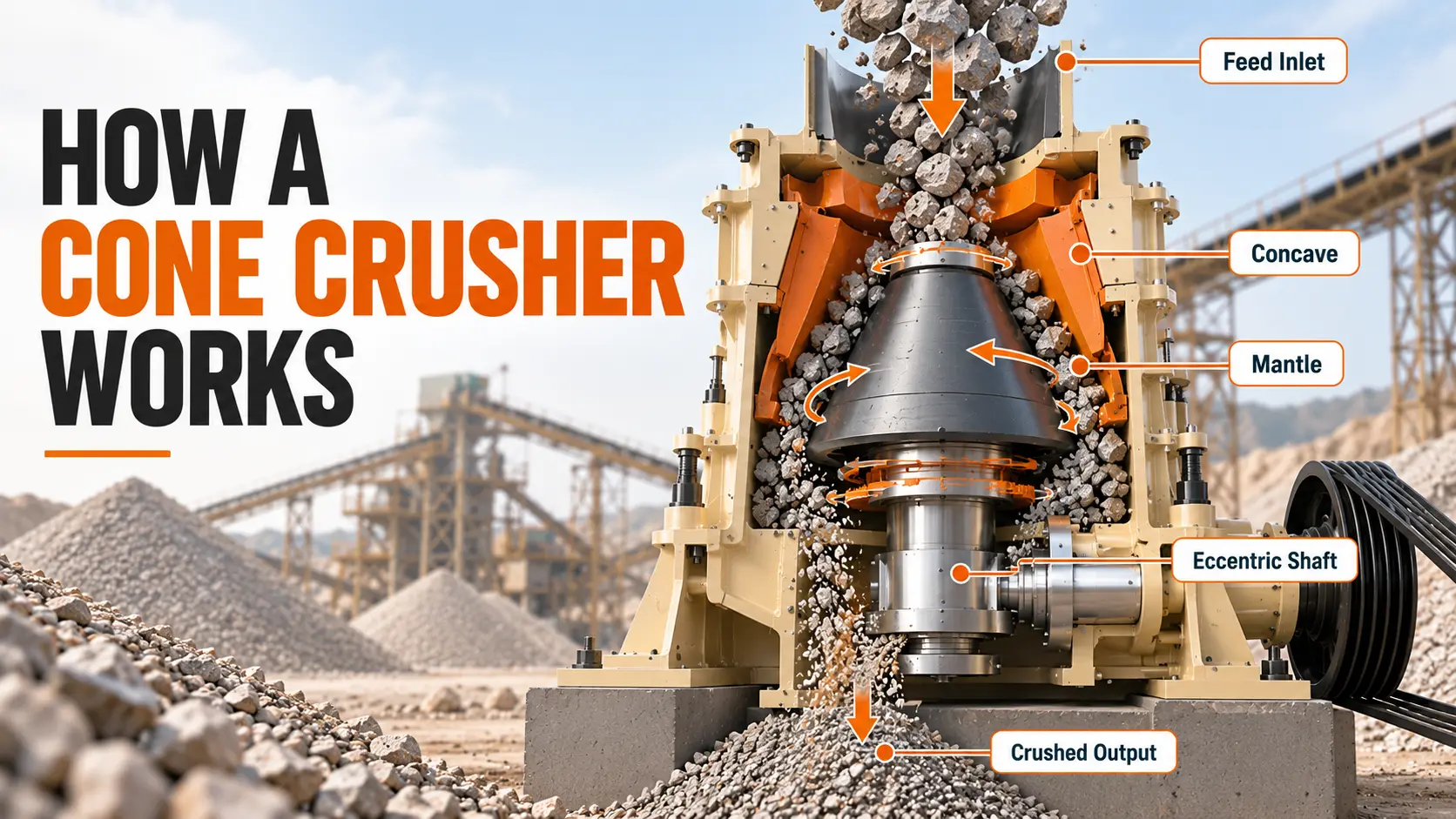
Cone crusher working principle diagram
The diagram below shows the main components and the direction of material flow. On the right side the mantle is close to the concave, which is the crushing side. On the left the gap is wide, which is where crushed material drops out.
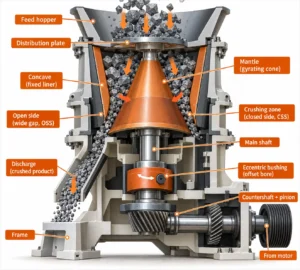
Figure 1: Cone crusher working principle (schematic cross-section).
The Crushing Chamber and Crushing Action
The space between the mantle and concave is called the crushing chamber or cavity. Its shape is one of the biggest influences on how the crusher performs.
Compression and inter-particle crushing
Rock breaks in two ways. First, pieces are squeezed directly between the mantle and concave. Second, when the chamber is full, rocks are squeezed against each other. This inter-particle crushing produces a more cubical product and spreads wear more evenly across the liners.
Chamber profiles
Concaves are made in different profiles, usually described as coarse, medium, fine, and extra fine. A coarse chamber has a wide feed opening and suits larger feed with a larger discharge setting. A fine chamber has a longer parallel zone near the bottom, which keeps material under compression for longer and improves fineness and shape, at the cost of some capacity. Choosing the right chamber for your crushing stage is essential.
Key Operating Parameters
Several settings control what comes out of a cone crusher and how much of it you get:
- Closed Side Setting (CSS): the smallest distance between the mantle and concave at the discharge during the cycle. It is the main control for product size. A smaller CSS gives a finer product but lowers capacity and raises power draw.
- Open Side Setting (OSS): the largest distance between the mantle and concave. The difference between OSS and CSS is the throw.
- Throw (stroke): how far the mantle moves each cycle, decided by the offset of the eccentric. A longer throw generally increases capacity and allows coarser feed, while a shorter throw suits fine crushing.
- Eccentric speed: how fast the eccentric turns. Higher speed gives more crushing cycles per minute and suits finer products, but too high a speed can stop material from falling freely and cause packing. Follow the manufacturer’s recommended range.
- Reduction ratio: feed size divided by product size. A cone crusher typically works at about 4:1 to 6:1 in a single pass. Larger reductions are better handled in two stages.
Why Choke Feeding Matters
A cone crusher works best when its chamber is kept full, a condition called choke feeding. The feed level should sit near the top of the mantle, and material should arrive evenly around the full circumference of the chamber.
Choke feeding improves product shape, increases reduction through inter-particle crushing, spreads liner wear evenly, and keeps power draw steady. A starved crusher does the opposite: rock bounces around the chamber, liners wear unevenly, the product contains more flat and elongated particles, and effective capacity falls. Under-feeding also puts extra stress on bearings and the drive.
To keep the chamber choked, many plants use a surge bin, a variable-speed feeder, and a level sensor in the feed hopper. At the other extreme, feed with too many fines or wet clay can pack the chamber, so screening ahead of the cone crusher is good practice.
Overload Protection: Handling Uncrushable Material
Sometimes excavator teeth, drill bits, or other hard steel objects (called tramp metal) enter the chamber. A cone crusher is built to let such material pass without breaking the machine.
- In a spring cone crusher, heavy springs hold the bowl down. When tramp metal enters, the springs compress, the gap opens, and the object passes through.
- In a hydraulic cone crusher, cylinders and accumulators release oil so the bowl or main shaft can move, then return to the set position.
Magnets and metal detectors upstream are still strongly recommended, because repeated tramp events damage liners and shafts. We compare both protection systems in detail in our guide to spring vs hydraulic cone crushers.
Where the Cone Crusher Fits in a Plant
In a typical stone crushing plant, material flows from the feeder to a primary jaw crusher, then to a secondary cone crusher, then to a vibrating screen. A tertiary cone crusher or VSI may follow for finer products, with final screening at the end. Oversize material from the screen usually returns to the cone crusher in a closed circuit, which controls product size accurately.
Conclusion
A cone crusher works by squeezing rock between a gyrating mantle and a fixed concave. The motor drives the countershaft, the gears turn the eccentric bushing, and the eccentric makes the main shaft swing so that the gap in the chamber opens and closes continuously. Product size is controlled mainly by the closed side setting and the chamber profile, while capacity and shape depend on choke feeding, throw, speed, and feed quality.
Once you understand this motion, decisions about settings, liners, and feed arrangements become much easier. If you are planning a new crushing plant or upgrading an existing one, speak to an experienced manufacturer who can match the chamber, capacity, and CSS to your material.
Frequently Asked Questions
Is a cone crusher a primary or secondary crusher?
Cone crushers are normally used for secondary and tertiary crushing, because their feed opening is smaller than that of a jaw or large gyratory crusher. A primary crusher prepares the feed first.
What is the difference between a cone crusher and a gyratory crusher?
Both crush by compression and use a gyrating mantle. A gyratory crusher has a steeper cone and a much wider feed opening, so it is used for primary crushing. A cone crusher has a flatter cone and a parallel zone near the discharge, which suits secondary and tertiary crushing and gives better product shape.