When you shop for a cone crusher, one of the first decisions you face is whether to buy a spring model or a hydraulic model. Both crush rock by compression in the same way. The difference lies in how each machine holds its setting, protects itself from uncrushable material, and allows the operator to adjust product size.
That difference affects purchase price, productivity, maintenance workload, and how well the crusher fits your plant. This guide explains how each type works, compares them side by side, and gives you a practical framework for choosing.
Why the Protection System Matters
Every cone crusher must deal with material it cannot crush, such as excavator teeth, drill steel, or a large piece of metal that slips past the magnet. If the crusher were completely rigid, this tramp metal would break the main shaft, frame, or liners.
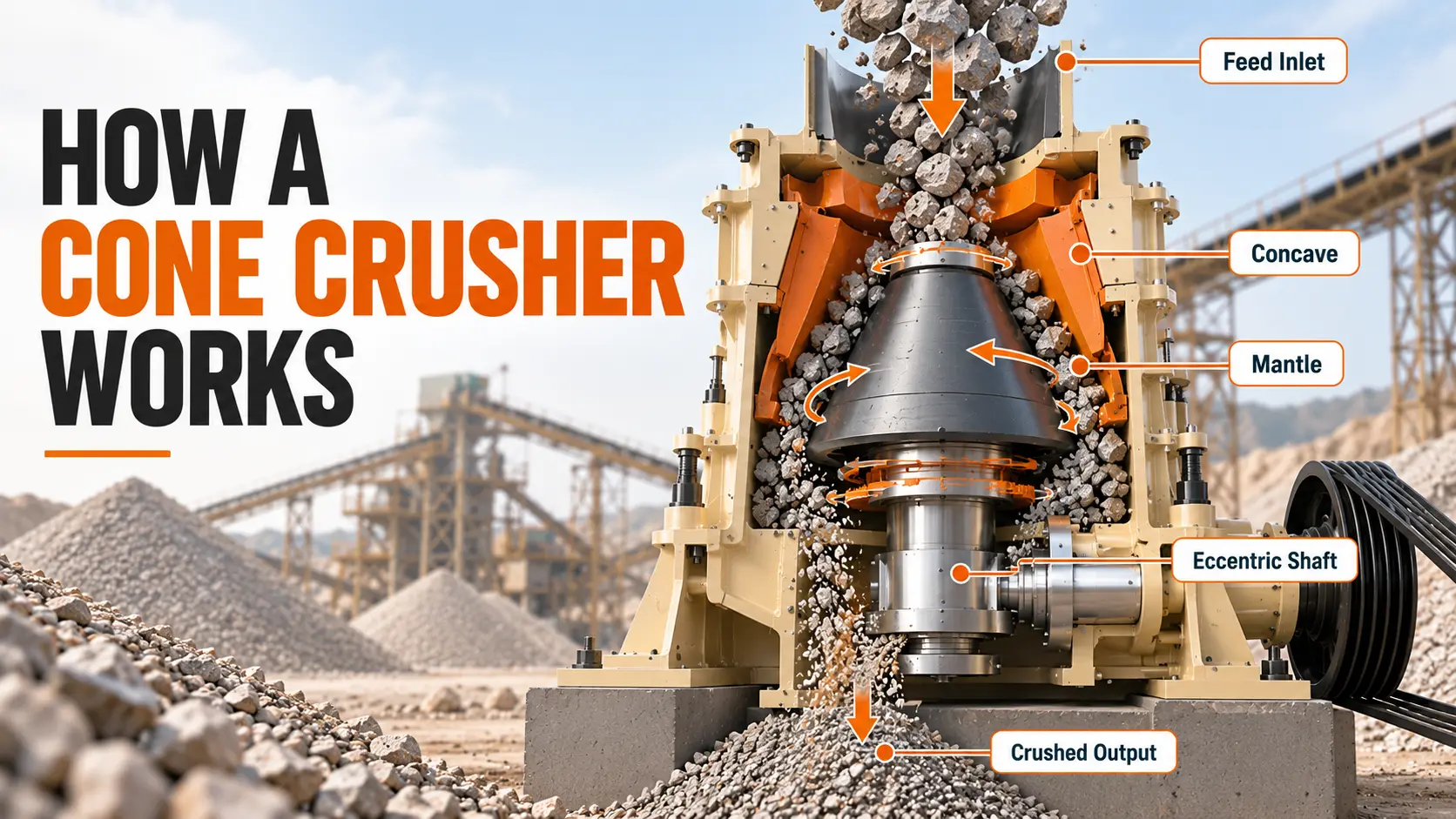
To prevent this, the bowl is held against the frame by a system that can give way under extreme load and then return to its position. In older and simpler designs that system is a ring of heavy springs. In modern designs it is a set of hydraulic cylinders with gas-charged accumulators. The same system also usually controls how the closed side setting (CSS) is adjusted, which is why the choice shapes so much of the machine’s behaviour.
What Is a Spring Cone Crusher?
In a spring cone crusher, a set of large springs arranged around the frame clamps the adjustment ring and bowl down onto the main frame. The springs are pre-compressed so that normal crushing forces do not move the bowl. If tramp metal enters the chamber, the force rises, the springs compress, the bowl lifts, and the object passes through. The springs then push the bowl back into position.
The closed side setting is adjusted by rotating the bowl or adjustment ring on its threads. This is usually done manually, and typically with the crusher stopped.
Advantages of spring cone crushers
- Lower purchase price
- Simple, proven mechanical design
- Easy for operators and local mechanics to understand and repair
- Fewer specialised components and less need for clean hydraulic oil
Limitations of spring cone crushers
- Setting changes are slow and normally require stopping the machine
- Clearing a packed chamber is harder and takes longer
- Overload protection is less precise, and repeated tramp events are harder on the machine
- Little or no automation, so CSS drifts as liners wear and product size changes
- Generally lower capacity and less consistent product shape than hydraulic machines
Best suited for: small and medium plants, lower production targets, tighter budgets, and operations with fairly consistent feed and strong local mechanical support.
What Is a Hydraulic Cone Crusher?
A hydraulic cone crusher replaces the springs with hydraulic cylinders and accumulators. Hydraulic pressure holds the crushing position. When uncrushable material enters, pressure rises, oil flows into the accumulators, the bowl or main shaft moves to open the gap, and the object passes through. Once the object has passed, the accumulators push the oil back and the crusher returns to its set position, usually within moments.
Hydraulic systems also adjust CSS quickly. Instead of turning a heavy ring by hand, the operator changes the setting with a control panel, often while the crusher is running. Many machines can also clear the chamber automatically if it packs, by lowering the bowl or shaft and then restarting.
Single-cylinder vs multi-cylinder designs
Hydraulic cone crushers come in two main layouts:
- Single-cylinder: one large hydraulic cylinder sits under the main shaft and supports it. CSS is adjusted by raising or lowering the shaft, and tramp release is handled by oil leaving the cylinder. These designs are common in large, high-capacity crushers and have a relatively simple structure.
- Multi-cylinder: several smaller cylinders around the bowl or adjustment ring hold the bowl in place and handle tramp release and adjustment. These designs are widely used for medium and fine crushing and can allow higher crushing forces in a compact machine.
Neither is better in every case. The right layout depends on the manufacturer’s design, chamber options, and your application.
Advantages of hydraulic cone crushers
- Fast CSS adjustment, often while the crusher is running
- Automatic overload protection and quick chamber clearing
- Higher capacity and more consistent product shape
- Support for automation, so CSS can be adjusted continuously to compensate for liner wear
- Less downtime for adjustments and blockages
Limitations of hydraulic cone crushers
- Higher initial cost
- More complex, with more components to maintain
- Needs clean hydraulic oil, good filtration, and trained technicians
- Repairs may depend on manufacturer service support
Best suited for: large quarries, mining, high-volume aggregate plants, and operations with tight product specifications or where uptime is critical.
Spring vs Hydraulic Cone Crusher: Side-by-Side Comparison
| Factor | Spring Cone Crusher | Hydraulic Cone Crusher |
| Initial cost | Lower | Higher |
| Overload protection | Mechanical, via springs | Hydraulic, via cylinders and accumulators |
| CSS adjustment | Manual, usually with the crusher stopped | Fast, often from a control panel while running |
| Clearing blockages | Slow and manual | Quick, often automatic |
| Capacity | Moderate | Higher |
| Product shape | Good, less consistent | More consistent |
| Automation | Limited | Strong, with CSS compensation for wear |
| Maintenance | Simple and familiar | More specialised |
| Operator skill needed | Basic | Moderate to high |
| Typical use | Small to mid-size plants | Large, high-output plants |
Cost: Look Beyond the Purchase Price
Spring crushers cost less to buy, and for a plant with a limited budget that is a strong argument. However, purchase price is only part of the story. A better way to compare machines is total cost of ownership, which includes:
- Purchase and installation cost
- Liner and spare parts consumption per tonne
- Downtime for adjustment, blockages, and repairs
- Energy and labour
A hydraulic crusher can recover its higher price through higher throughput, better product quality, and more uptime, particularly in high-tonnage or abrasive applications. In a small plant that runs a few hours per day on soft or medium rock, a spring crusher may deliver a better return. Ask suppliers for quotations based on your actual tonnage and rock type, and compare cost per tonne rather than price per machine.
Maintenance: What to Expect
A spring crusher has fewer systems to look after, but its adjustment threads and springs need regular cleaning, checking, and lubrication. Dust and fines can lock the adjustment ring, and fatigued springs can lose preload.
A hydraulic crusher adds a hydraulic circuit, accumulators, valves, hoses, and sensors. The accumulators need correct gas pre-charge, the oil needs to stay clean and cool, and hoses and seals must be inspected for leaks. This work is not difficult, but it needs training and the right tools. Planned maintenance is essential to realise the benefits of hydraulic systems.
How to Choose: A Practical Guide
Ask these questions
- What is your production target? Plants aiming for high daily tonnage generally benefit from hydraulic machines.
- How abrasive is your rock? Abrasive rock wears liners quickly, and hydraulic CSS compensation helps keep product size steady.
- How tight are your product specifications? If you supply to road, rail, or ready-mix customers with strict gradation requirements, hydraulic control and consistency are valuable.
- How skilled is your maintenance team? If your mechanics are experienced with mechanical equipment but not hydraulics, a spring machine may be safer, or budget for training.
- How good is the supplier’s service support? Check spare parts availability, local technicians, and response times before you decide.
- What is your budget and expected payback period? Compare total cost of ownership over several years.
Quick scenarios
- Small stone crusher plant, limited budget, steady feed: a spring cone crusher is usually sufficient.
- Large quarry or mining operation running multiple shifts: a hydraulic cone crusher is typically the better investment.
- Manufactured sand or fine aggregate production: hydraulic, especially multi-cylinder machines with fine chambers, are commonly preferred for tight control and shape.
- Mobile or portable plants: hydraulic machines are common because setting changes and clearing can be done quickly on site.
Conclusion
Spring and hydraulic cone crushers use the same crushing principle, but they differ in how they protect themselves, how easily they are adjusted, and how much they cost to buy and run. Spring models are simple, affordable, and well suited to smaller plants with steady feed. Hydraulic models cost more but deliver faster adjustment, stronger protection, higher capacity, and automation that keeps product consistent as liners wear.
The right choice depends on your tonnage, rock, product specification, maintenance capability, and budget. Compare total cost of ownership, check the supplier’s service support, and discuss your application with an experienced manufacturer before you decide.
Frequently Asked Questions
Is a hydraulic cone crusher always better than a spring cone crusher?
No. Hydraulic machines offer more control, capacity, and uptime, but they cost more and need better maintenance. For small plants with steady feed, a spring crusher can be the more economical choice.
Can the closed side setting be changed while the crusher is running?
On many hydraulic machines, yes. On spring machines the adjustment is normally done with the crusher stopped.