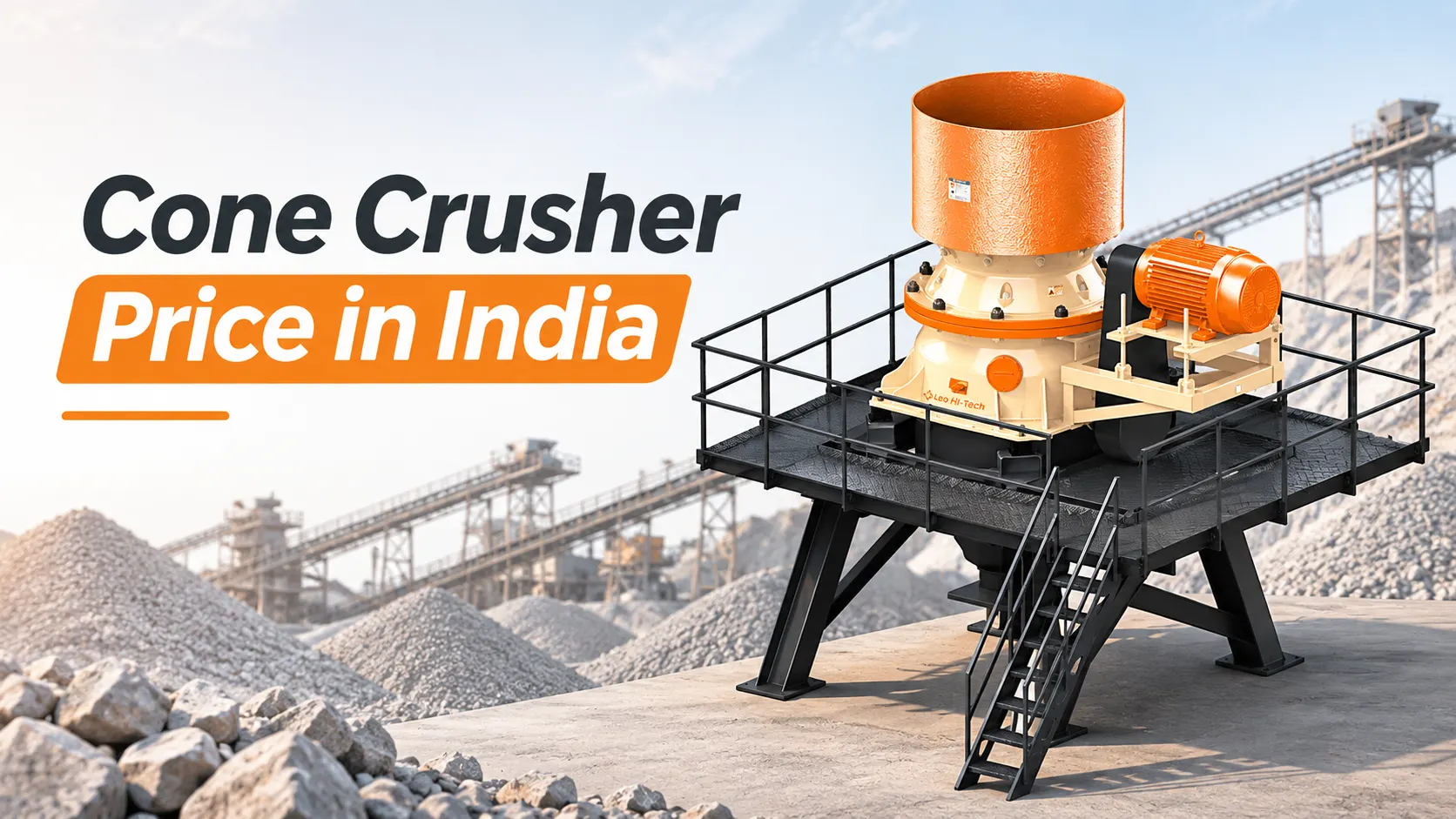
A cone crusher is where a crushing plant earns its money. It turns rough primary output into the cubical, well-graded aggregate and M-Sand feed that customers pay for. That also makes it one of the larger machinery purchases in your plant, so it pays to understand what drives its price before you ask for quotations.
This guide covers typical cone crusher prices in India by capacity, how spring and hydraulic models affect cost, what Leo’s cone crusher ranges offer, and how to look beyond the purchase price. Figures are indicative market ranges for 2026, so confirm every number with a written quotation.
Cone Crusher Price in India: Typical Ranges
|
Capacity (TPH) |
Typical Application |
Indicative Price Range |
|
50 – 60 |
Small secondary stage |
₹18 – ₹25 lakh |
|
100 |
Mid-sized aggregate plants |
₹25 – ₹38 lakh |
|
150 – 200 |
Large commercial plants, highway work |
₹45 – ₹80 lakh |
|
250 – 350 |
Quarry-scale production |
₹80 lakh – ₹1.4 crore |
Spring models sit toward the lower end of each range, while multi-cylinder or single-cylinder hydraulic machines with automation sit toward the upper end or above. The ranges are for the crusher unit. GST, freight, foundations, lubrication systems if not included, and electricals are usually extra.
What Drives Cone Crusher Price?
- Size and power: a larger mantle diameter and bigger motor mean a heavier, costlier machine. Leo’s LCG range, for example, goes from the LCG 100 (75–90 kW) to the LCG 500 (300–400 kW).
- Spring or hydraulic: hydraulic overload protection and CSS adjustment cost more than a spring system.
- Chamber and liner options: coarse, medium, and fine chambers, and the manganese grade of the mantle and concave, change the price and the wear life.
- Shaft and bearing design: floating or fixed shaft layouts, bushings versus roller bearings, and the quality of the castings all affect cost and reliability.
- Automation: on-the-go CSS adjustment, sensors, and monitoring add to the quote but keep product size consistent as liners wear.
- Lubrication system: a good cooled and filtered oil system is essential. Check that it is included.
- Brand and support: local stock of liners and spares, and trained service engineers, are part of what you pay for.
Spring vs Hydraulic: How Type Affects Price
Spring cone crushers are simpler and cheaper to buy. They suit smaller plants with steady feed and a mechanically skilled team. Hydraulic cone crushers cost more but allow faster setting changes, quicker chamber clearing, and higher capacity. For a plant running multiple shifts on abrasive rock, the extra uptime and consistent product often repay the higher price. We compare both designs in detail in our guide to spring vs hydraulic cone crushers.
Matching the Model to Your Application
Price only makes sense once the machine fits the job. Cone crushers serve different stages:
- Secondary crushing: a coarser chamber takes feed from the jaw crusher and reduces it for screening. Leo’s LCG series covers this range, with output from about 40 TPH on the LCG 100 up to about 580 TPH on the LCG 500, depending on stroke and CSS.
- Tertiary and fine crushing: a finer chamber with a longer parallel zone gives better shape and a smaller product. Leo’s LCB series is a tertiary-type fine head crusher with hydraulic CSS adjustment and roller bearing construction.
- M-Sand feed: the LCB Sander models are designed for fine crushing, with the LCB100 Sander producing roughly 90–125 TPH at a 13 mm CSS and the LCB200 Sander roughly 170–190 TPH.
Ask suppliers for capacity at your CSS and stroke, and match the maximum feed size to what your primary crusher produces. The LCB200 XC, for instance, accepts feed up to 200 mm, while the LCB200 MC accepts up to 165 mm.
Running Costs: Why the Cheapest Machine Can Cost More
Over several years, operating costs often exceed the difference in purchase price. Look at these:
- Power: a 160 kW cone crusher at full load on ₹8 per kWh grid power uses about ₹1,280 of electricity an hour. At 150 TPH, that is roughly ₹8.5 per tonne.
- Liners: mantle and concave are the main wear parts. Easy liner changes, such as designs without backing compound, cut downtime.
- Downtime: every hour lost to adjustments, blockages, or repairs costs production.
- Product quality: a crusher that makes more cubical, correctly graded product sells for more per tonne.
The sensible way to compare machines is cost per tonne of finished product, not price per machine. Our cone crusher maintenance checklist shows how daily checks protect that number.
Price per TPH: A Quick Sanity Check
Dividing the price by capacity gives a quick benchmark. Using the indicative ranges above, a 60 TPH cone crusher costs roughly ₹30,000–42,000 per TPH, while a 100 TPH machine costs about ₹25,000–38,000 per TPH. If a quotation falls far below these levels, ask what has been left out, such as the lubrication unit, a full liner set, or the electrical panel. If it is far above, ask what extra capability you are paying for, such as automation or a hydraulic setting system.
Budgeting for Liners and Spares
Never treat the first liner set as an afterthought. Order a spare mantle and concave along with the machine, or confirm that your supplier can deliver them within days. Keep a stock of seals, filters, and the lubrication components most likely to fail. Spare parts add to your initial outlay, but a plant that waits two weeks for a liner loses far more in production than the parts cost. Record the tonnes crushed on each liner set from the start.
Installation and Commissioning
A cone crusher needs a rigid reinforced concrete foundation, correct alignment with the feeder and discharge conveyor, and a properly set up lubrication and cooling system. Ask whether the quotation includes supervision of installation, commissioning, and operator training. Poor installation is a common cause of early failures, so these services are worth paying for.
New vs Used Cone Crushers
Used cone crushers are widely advertised, but they carry more risk than used jaw crushers because the internals are complex. Shaft wear, eccentric bushing damage, and gear problems are hard to see without a teardown, and spares for older models can be difficult to source. If you consider a used machine, insist on an inspection report, oil analysis, and a written warranty. For plants running daily, a new machine with factory support usually gives a lower cost per tonne.
Questions to Ask Before You Buy
- What capacity does the machine deliver at my CSS and rock type?
- Is the overload protection spring or hydraulic, and can CSS be changed while running?
- Which chamber options and liner materials are available, and what is the expected liner life?
- Is the lubrication system included, and how is oil temperature monitored?
- How quickly can you deliver wear parts, and do you provide commissioning and training?
- Can I visit a running plant with a similar machine?
Where the Cone Crusher Fits in Plant Cost
A cone crusher is one item in a larger investment. In a 100–200 TPH plant, total machinery usually costs ₹80 lakh to ₹2.5 crore, with land, civil works, licensing, and power on top. See our guide to the cost of a stone crusher plant in India for the full picture.
Conclusion
Cone crusher prices in India range from about ₹18–25 lakh for a 50–60 TPH machine to well over a crore for quarry-scale units, with hydraulic models costing more than spring models. The better question is what each machine costs per tonne of good product once power, liners, and downtime are counted.
Frequently Asked Questions
What is the price of a 100 TPH cone crusher in India?
Indicatively about ₹25–38 lakh for the crusher unit. The final price depends on spring or hydraulic design, chamber, and included accessories.
Is a hydraulic cone crusher more expensive than a spring one?
Generally yes. The higher price buys faster adjustment, stronger overload protection, and often higher capacity.
Can I use a cone crusher without a jaw crusher?
A cone crusher needs feed that has already been broken down and, ideally, screened. A primary crusher such as a jaw crusher normally comes first.
Does the price include the first set of liners?
Usually the machine is supplied with a fitted mantle and concave, but confirm this in writing, along with the chamber profile and liner material. Ask for the price of a spare set at the same time.
How long do the mantle and concave last?
It varies with rock abrasiveness, feed control, and liner quality. Record tonnes crushed per set so you can predict changes and compare suppliers.