Restrictions on river sand mining have pushed Manufactured Sand (M-Sand) from an alternative to a mainstream construction material. Builders and ready-mix plants now actively look for consistent, well-graded M-Sand, which makes a sand plant one of the more attractive additions to a crushing business.
This guide breaks down what an M-Sand plant costs in India, from the VSI crusher and washing unit to licensing and land, and shows how to estimate returns. Figures are indicative ranges for 2026 and vary by state and supplier, so always confirm with a written quotation.
What Is an M-Sand Plant?
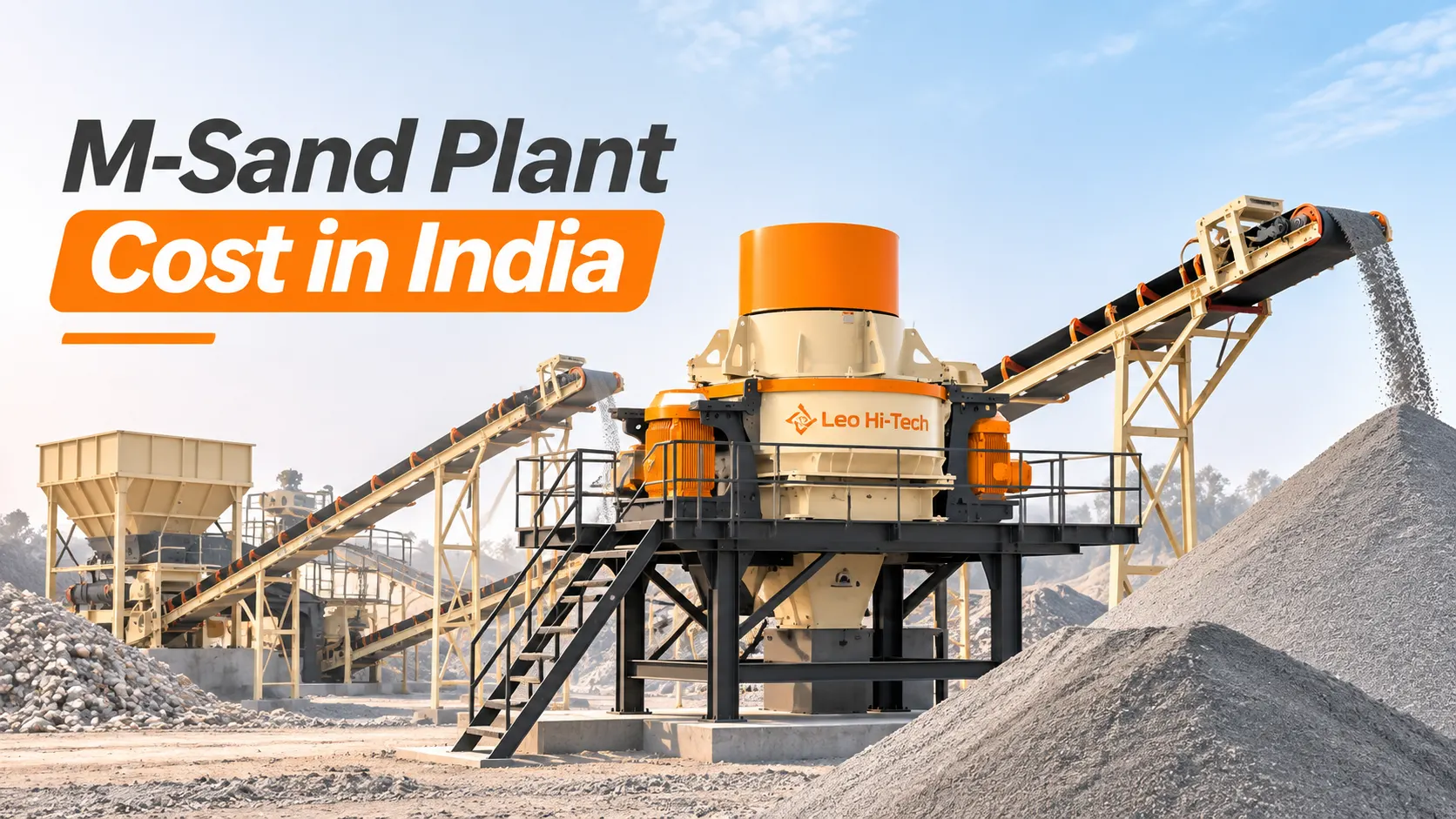
An M-Sand plant crushes hard rock such as granite, basalt, or quartzite into sand-sized particles. The key machine is a Vertical Shaft Impactor (VSI). It throws rock at high speed against rock lining inside the chamber, and this rock-on-rock crushing produces cubical particles with good shape, which is what concrete needs.
A typical process runs from a jaw crusher to a cone crusher, then the VSI, then a screen that separates sand from oversize. A washing unit removes excess fines and dust, giving a cleaner, more consistent product that sells at a premium.
M-Sand Plant Cost: Equipment Breakdown for 100 TPH
The table below shows indicative costs for the equipment in a new 100 TPH M-Sand plant, from rock input to washed sand.
|
Equipment |
Indicative Cost |
Notes |
|
Jaw crusher (primary) |
₹18 – ₹28 lakh |
100 TPH class |
|
Cone crusher (secondary) |
₹25 – ₹38 lakh |
100 TPH class |
|
VSI crusher |
₹38 – ₹55 lakh |
Sand-making stage |
|
Screens (primary and final) |
₹13 – ₹20 lakh |
Final M-Sand screen |
|
Conveyors |
₹12 – ₹18 lakh |
About 80–100 m of belt |
|
Washing system |
₹26 – ₹45 lakh |
Washer, dewatering, recycling |
|
Electrical and controls |
₹18 – ₹32 lakh |
Panels, cabling, automation |
|
Total equipment |
₹1.5 – ₹2.4 crore |
Sum of items above |
Other Project Costs to Include
- Storage bunkers and civil work: ₹15–25 lakh for bunkers, plus foundations, ramp, and control cabin.
- Weighbridge: ₹8–12 lakh installed.
- Power connection: a transformer for a plant of this size costs roughly ₹4–7 lakh, plus the cost of the line from the grid.
- Licensing and clearances: ₹10–30 lakh initially, covering Consent to Establish, Consent to Operate, NOCs, and consultancy.
- Land: buying costs vary hugely by location. Leasing is often cheaper at the start, as in a typical stone crusher plant.
- Contingency: add 15–20% for price changes and unplanned items.
Adding the equipment total to the bunkers, weighbridge, transformer, and licensing gives roughly ₹1.9–3.1 crore. With a 15–20% contingency, a complete new 100 TPH M-Sand plant lands at about ₹2.1–3.7 crore, excluding land. This sits within the machinery range we gave in our guide to the cost of a stone crusher plant in India.
Adding M-Sand to an Existing Crusher Plant
If you already run a jaw and cone crushing plant, you only need the sand-making stage. Many operators budget about ₹30–60 lakh for a compact VSI and washing circuit. For a 100 TPH sand circuit, the VSI alone can cost ₹38–55 lakh, and with a final screen and washing system the add-on typically reaches ₹70 lakh to ₹1.1 crore. Because M-Sand commands a better price than standard aggregate, this addition can shorten your overall payback.
Choosing the Right VSI Crusher
The VSI is the heart of the plant, so size it carefully. Leo’s L-series VSI range shows how capacity scales:
- Light L-Series (L-75, L-110, L-150): accept feed up to 32 mm and produce roughly 60, 100, and 135 TPH of M-Sand or fine crushing.
- Heavy L-Series (L-185, L-220, L-320): accept feed up to 45 mm and produce roughly 170 to 295 TPH.
- Mega L-Series (L-370, L-440, L-600): also accept feed up to 45 mm and produce roughly 335 to 590 TPH.
Features to look for include rock-on-rock crushing, a high-speed rotor with 3, 4, or 5 ports, a chamber access door for quick maintenance, and a cascade system for better material flow and energy efficiency. Because the VSI accepts only small feed, your cone crusher must deliver the right size, so plan the whole circuit and not just one machine.
Power Load and Electrical Planning
A 100 TPH plant typically needs a connected load of about 400–500 HP once crushers, screens, conveyors, and pumps are counted. Most of that comes from the crushers. For example, Leo’s L-110 VSI uses a 110 kW motor for about 100 TPH of M-Sand, and a cone crusher of the right size adds 130–160 kW or more. Confirm the total load with your supplier early, because it decides the transformer size, cabling, and electricity board approvals.
Do You Need a Washing Unit?
Dry M-Sand often contains too many fines and dust for high-grade concrete. A washing unit removes the excess fines and improves cleanliness and gradation. Washed M-Sand typically sells for ₹300–500 per tonne more, while washing adds roughly ₹150–200 per tonne to production cost, so the margin can repay the washing system within a year.
Water is the main planning issue. Expect fresh water use of about 300–500 litres per tonne of sand produced, falling sharply if you recycle 80–90% of wash water through settling tanks or a thickener. Check that your site has a reliable borewell or water source, and include a recycling system in the budget.
Product Quality: What Buyers Look For
Price depends on quality. Buyers of M-Sand, especially ready-mix plants and large builders, look for cubical particle shape, a consistent gradation within the fine aggregate zone they specify, and controlled fines. Good shape comes from rock-on-rock crushing in the VSI, a well-set cone crusher upstream, and a clean final screen. Test the sand regularly and keep records, because consistent, documented quality is what lets you win repeat customers and a premium price.
Revenue and Payback: A Simple Estimate
M-Sand prices vary by state and quality. Licensed M-Sand has been reported at about ₹1,400–1,800 per tonne in some southern markets, and washed grades fetch more. To illustrate with the margin used in our cost guide, a 100 TPH plant running at 80% efficiency for one 8-hour shift produces 640 tonnes a day. At a net margin of ₹100 per tonne, that is ₹64,000 a day, or about ₹16 lakh a month over 25 working days.
Real margins depend on rock cost, power, wear parts, and selling price. Many plants estimate payback of about 18–24 months, shorter if they sell washed sand at a premium. Build your own projection from local prices instead of relying on any generic figure.
Land, Water and Licensing
- Land: a 100 TPH plant typically needs 2–4 acres for machinery, truck movement, and stockpiles.
- Approvals: you need Consent to Establish and Consent to Operate from your State Pollution Control Board, plus local NOCs. These can take 3 to 8 months, so start early.
- Dust control: water sprinklers, covered conveyors, and boundary walls are usually mandatory.
- Quality standards: your sand should meet the relevant Indian Standard for fine aggregate, so buyers can use it in concrete without concerns.
Common Mistakes to Avoid
- Buying machines one at a time without checking that feed and output sizes match.
- Under-sizing the water supply and discovering it only after the washing unit is installed.
- Ignoring the market: check local sand prices and demand before choosing your capacity.
- Skipping contingency: costs almost always rise during civil work and approvals.
- Choosing on price alone: weak spares and service support cost more than the discount saves.
Tips to Control M-Sand Plant Cost
- Design the full circuit first, then choose machines that match each other’s feed and output.
- Lease land near the quarry instead of buying it at the start.
- Compare quotations on the same specification, including liners, motors, and electricals.
- Include water recycling from day one to cut water costs and approval problems.
- Choose a supplier who provides commissioning, training, and spare parts.
Conclusion
An M-Sand plant is a sizeable investment, but it addresses a clear market gap. A new 100 TPH plant costs about ₹2.1–3.7 crore excluding land, while adding sand production to an existing crushing plant typically costs ₹30 lakh to ₹1.1 crore depending on capacity. Plan the full circuit, budget for water and licensing, and compare suppliers on specification and support.
Frequently Asked Questions
What is the cost of a 100 TPH M-Sand plant in India?
Indicatively ₹2.1–3.7 crore for a complete new plant including crushers, VSI, screens, washing, electricals, and contingency, excluding land. Adding a sand circuit to an existing plant costs less.
Is the M-Sand business profitable?
It can be, because M-Sand commands a better price than standard aggregate and demand is strong where river sand is restricted. Profit depends on local prices, rock cost, power, and plant efficiency.
Do I need a VSI crusher to make M-Sand?
A VSI is the most common machine for M-Sand because it produces cubical particles with good shape. Some plants use fine cone crushers, such as sander-type models, for the same job.
Can I add M-Sand production to my existing stone crusher plant?
Yes. You add a VSI, a final screen, and ideally a washing unit after your cone crusher, provided your feed size and power supply suit the VSI.
To get a tailored estimate for your site, share your target capacity, rock type, and whether you already have a crushing plant, and our team will help you design the right M-Sand setup.
Suggested meta title: M-Sand Plant Cost in India 2026: Machinery, VSI and Setup
Suggested meta description: A practical breakdown of M-Sand plant cost in India, covering VSI crusher, washing unit, screens, licensing, land and expected returns.