India is currently undergoing an unprecedented infrastructure boom. Driven by massive capital allocations toward the National Highways Authority of India (NHAI), urban real estate expansion, and rural connectivity projects, the demand for high-quality construction aggregates and Manufactured Sand (M-Sand) is at an all-time high.
For entrepreneurs, civil contractors, and investors, establishing a stone crushing plant presents a highly lucrative business opportunity. However, a crushing plant is a capital-intensive, heavy-engineering project. Successfully launching one requires a deep understanding of not just the machinery, but the hidden costs of civil works, legal compliance, and operational logistics.
How much does it cost to set up a stone crusher plant in India?
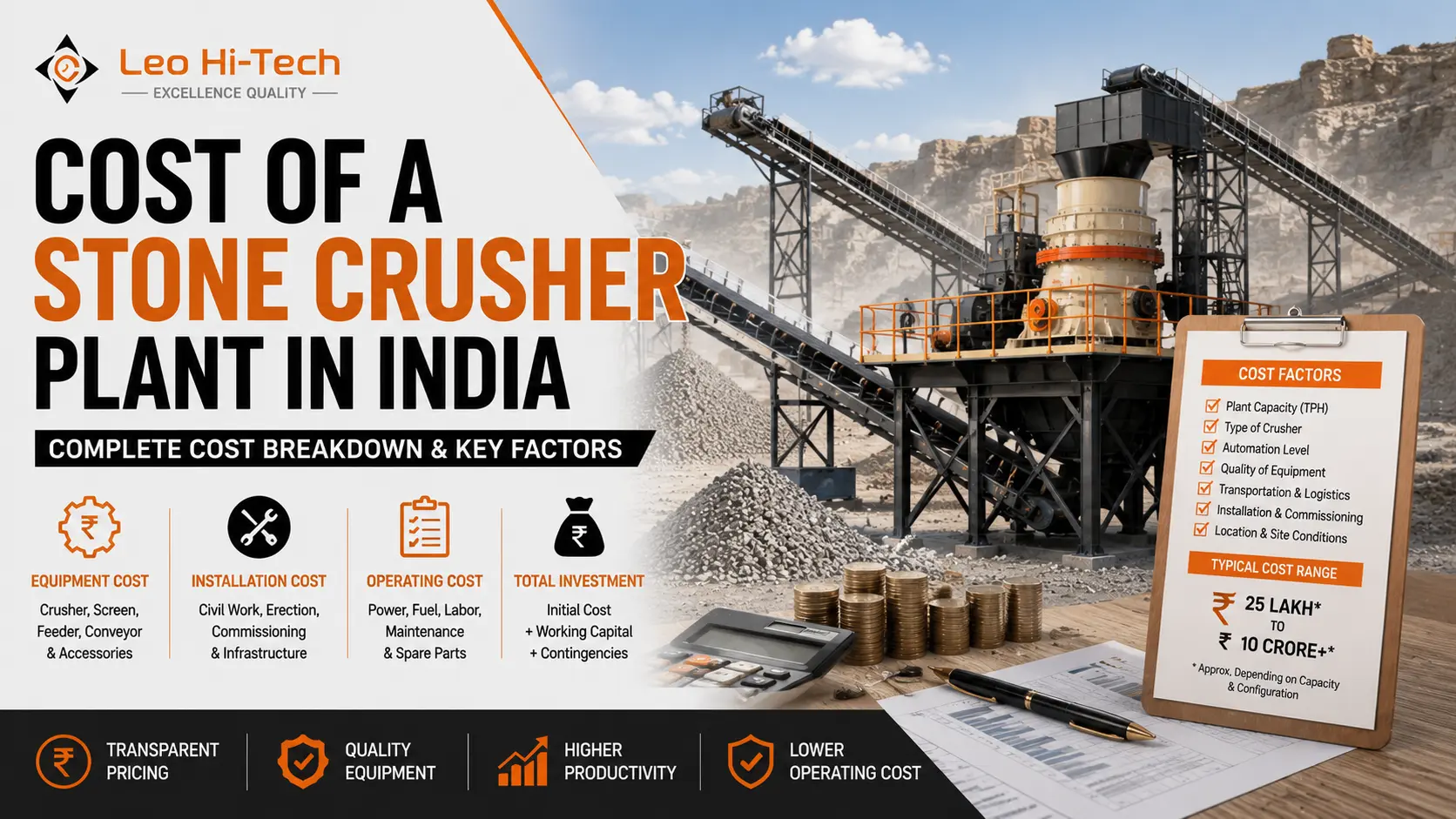
Setting up a standard 100 to 200 TPH (Tons Per Hour) stone crusher plant in India typically costs between ₹1.5 Crores and ₹5 Crores. This total includes the initial machinery investment (₹80 Lakhs to ₹2.5 Crores), land acquisition and civil works (₹40 Lakhs to ₹1 Crore), government licensing, and initial working capital.
This comprehensive 2026 guide breaks down the true cost of setting up a stone crusher plant in India, providing a realistic roadmap for your capital expenditure (CapEx) and operational return on investment (ROI).
The 4 Major CapEx (Capital Expenditure) Pillars
A common mistake new investors make is assuming that the price of the crushers is the total cost of the project. In reality, the machinery is just one piece of the puzzle. To build an accurate project report and secure bank financing, you must divide your investment into four major pillars:
- Machinery and Equipment
- Land Acquisition and Civil Works
- Government Licensing and Clearances
- Power Infrastructure and Working Capital
Below is a detailed breakdown of each pillar to help you forecast your initial investment.
1. Machinery and Equipment Costs (By Capacity)
The heart of your investment lies in the crushing circuit. The cost of your machinery is directly dictated by your target production capacity, measured in Tons Per Hour (TPH), and the types of rocks you intend to process (e.g., hard granite vs. softer limestone).
A standard multi-stage crushing plant includes a vibrating grizzly feeder, a primary jaw crusher, a secondary cone or impact crusher, vibrating screens, and a network of conveyor belts.
| Plant Capacity (TPH) | Ideal Business Application | Estimated Machinery Cost (INR) |
| 50 – 100 TPH | Small-scale local contractors, rural road projects. | ₹50 Lakhs – ₹90 Lakhs |
| 100 – 200 TPH | Mid-sized commercial aggregate suppliers, standard real estate. | ₹80 Lakhs – ₹2.5 Crores |
| 200 – 300+ TPH | Large-scale NHAI highway projects, major infrastructure. | ₹2.5 Crores – ₹5+ Crores |
Adding Value with Manufactured Sand (M-Sand)
Due to severe environmental restrictions on river sand mining across Indian states, the demand for Manufactured Sand (M-Sand) has skyrocketed. If you intend to produce M-Sand, you must add a tertiary crushing stage to your plant, specifically a Vertical Shaft Impactor (VSI).
- Cost Impact: Integrating a high-quality VSI crusher and an M-Sand washing unit will add approximately ₹30 Lakhs to ₹60 Lakhs to your total machinery CapEx. However, because M-Sand commands a premium price in the market, this addition significantly shortens your ROI timeline.
Automation and Electrical Panels
Do not overlook the cost of the central control system. A fully automated PLC (Programmable Logic Controller) panel ensures systemic harmony across the plant, preventing bottlenecks and motor burnouts. High-quality electrical panels and plant automation systems will account for roughly 5% to 8% of your machinery budget.
2. Land Acquisition and Civil Works
You cannot simply place a 50-ton machine on the dirt and start crushing. The structural integrity of your plant relies on heavy civil engineering.
Land Requirements
To operate a 100 to 200 TPH plant safely, you will need a minimum of 2 to 5 acres of land. This space is required not just for the machinery, but for the safe maneuvering of heavy dump trucks, raw boulder stockpiles, and segregated final aggregate piles.
- Cost Factor: Land costs vary wildly depending on the state and proximity to cities. Most operators choose to lease barren land near a quarry rather than purchase it outright, drastically reducing initial CapEx. Expect lease costs to range from ₹5 Lakhs to ₹15 Lakhs per annum.
Civil Foundations and Plant Construction
Jaw crushers and cone crushers generate massive kinetic energy and vibration. They require deep, reinforced concrete foundations.
- Concrete Pads: Pouring the structural foundations for the crushers, vibrating screens, and conveyor support legs.
- The Ramp: You must construct a massive, reinforced earth-and-concrete ramp so dump trucks can reverse and drop raw boulders directly into the primary feeder hopper.
- Infrastructure: Building a centralized control cabin, a site office, security fencing, and a weighbridge (Dharam Kanta) to accurately bill outgoing trucks.
- Cost Factor: Civil works are heavily influenced by local steel and cement prices but generally range between ₹40 Lakhs to ₹1 Crore for a mid-sized plant.
3. Government Licensing and Environmental Clearances
Operating a stone crusher in India involves strict regulatory compliance. Failing to secure the correct permits will result in your plant being shut down immediately by district authorities. Budgeting for legal fees, consultation, and processing time is critical.
- State Pollution Control Board (SPCB): You must obtain two critical certificates from your state’s pollution control board: the Consent to Establish (CTE) before building, and the Consent to Operate (CTO) before turning the machines on. You will also be mandated to install dust suppression systems (water sprinklers) and wind-breaking boundary walls.
- Mining and Geology Department: If you are operating your own quarry alongside the crusher, you need a valid mining lease, environmental clearance (EC) from the State Environment Impact Assessment Authority (SEIAA), and approved mining plans.
- Local Clearances: You will require a No Objection Certificate (NOC) from the local Gram Panchayat or municipality, as well as clearance from the Factory Inspectorate regarding worker safety.
- Cost Factor: Licensing fees, environmental impact assessments (EIA), and legal consultation typically cost between ₹5 Lakhs and ₹15 Lakhs, but the true cost here is time. Securing all NOCs can take anywhere from 3 to 8 months.
4. Power Supply (Electricity vs. DG Sets)
Crushing rock requires immense electrical power. A standard 150 TPH plant will require a connected load of approximately 400 to 600 kW. You have two options for powering your plant, and this decision drastically affects both CapEx and OpEx.
Grid Power (High Tension Line)
Running your plant on state grid electricity is by far the most profitable long-term strategy.
- CapEx: You must pay the state electricity board (e.g., BESCOM, MSEDCL, UPPCL) to draw a dedicated High Tension (HT) line to your site and install a heavy-duty step-down transformer (typically 500 kVA to 1000 kVA). This infrastructure setup can cost ₹15 Lakhs to ₹30 Lakhs upfront.
- OpEx: Grid electricity is significantly cheaper per unit (typically ₹7 to ₹9 per kWh).
Diesel Generator (DG) Sets
If your plant is in a remote area without grid access, you must rely on massive industrial DG sets.
- CapEx: Purchasing high-capacity DG sets (e.g., a 500 kVA Cummins or Kirloskar generator) will cost ₹20 Lakhs to ₹35 Lakhs.
- OpEx: Running a plant entirely on diesel destroys profit margins. The cost of power generated via diesel can easily exceed ₹20 to ₹25 per unit, making it difficult to compete with grid-powered plants on aggregate pricing.
Is a Stone Crusher Business Profitable in India? (ROI Calculation)
Despite the heavy initial capital required, the stone crushing business yields massive profitability when operated efficiently. Let us run a simplified ROI model for a 150 TPH Plant.
Revenue Generation
- If a 150 TPH plant operates at 80% efficiency for a single 8-hour shift, it produces roughly 1,000 tons per day.
- Assuming an average net profit margin of ₹100 per ton (after accounting for raw boulder costs, labor, electricity, wear parts, and diesel for loaders), the plant generates ₹1,00,000 in net profit per day.
- Operating 25 days a month yields a monthly net profit of ₹25,00,000.
Break-Even Timeline
At a conservative monthly profit of ₹25 Lakhs, a plant with a total initial CapEx of ₹3 Crores will reach its break-even point in just 12 to 18 months.
To maximize this profitability, plant managers must focus on preventive maintenance (to avoid costly downtime), maintain strict inventory control over wear parts like jaw plates and cone mantles, and optimize their crushing circuit to produce a higher percentage of premium M-Sand and 20mm aggregates, which yield the highest market rates.
Frequently Asked Questions
What is the minimum investment for a mini stone crusher?
A mini stone crusher plant (under 50 TPH) tailored for small rural projects or mobile contracting can be set up for an initial investment of ₹30 Lakhs to ₹50 Lakhs, focusing primarily on a single jaw crusher and a basic screening unit.
How much land is required for a 100 TPH stone crusher?
A standard 100 TPH stationary plant requires at least 2 to 3 acres of land. This ensures adequate space for the machinery footprint, truck maneuvering, weighbridge operations, and safe stockpiling of both raw boulders and finished aggregates.
Is M-Sand business more profitable than standard aggregate?
Yes, M-Sand (Manufactured Sand) is highly profitable. Due to nationwide bans on river sand mining, M-Sand commands a premium market price. Adding a VSI crusher to produce high-quality, washed M-Sand drastically increases a plant’s overall revenue and accelerates ROI.
Can I get an MSME or bank loan for a stone crusher plant in India?
Yes, stone crusher projects are eligible for term loans and working capital facilities from nationalized and private banks under the MSME sector. You will need a detailed Detailed Project Report (DPR), environmental NOCs, and collateral to secure financing.
What are the main running costs of a stone crusher?
The primary operational expenses (OpEx) include raw material (purchasing boulders), electricity or diesel consumption, wear parts replacement (jaw dies, cone mantles, screen mesh), loading equipment fuel (excavators and wheel loaders), and labor wages.