In the rock crushing industry, choosing the right machinery is important for keeping your plant running smoothly and staying within budget. For buyers and site managers designing a new setup, a common point of confusion is evaluating the jaw crusher and the cone crusher.
Often, people think these machines are competitors. Buyers wonder if they should spend their money on a jaw or a cone. The reality is that they are not competitors; they work together in a step-by-step process.
What is the difference between a jaw crusher and a cone crusher?
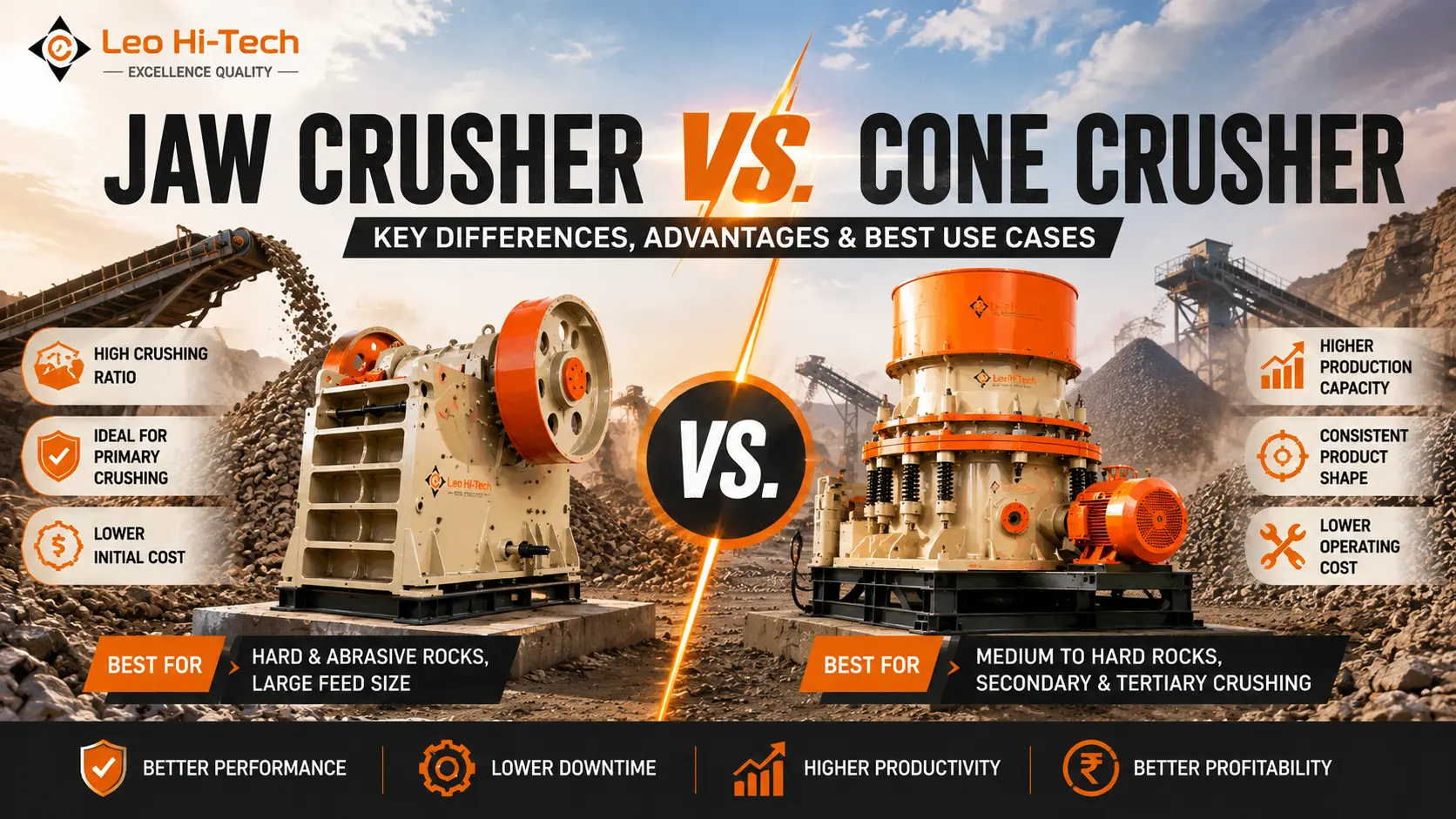
The main difference is their stage in the crushing process. A jaw crusher is a primary crusher used to break large, raw rocks down to a manageable size. A cone crusher is a secondary or tertiary crusher that takes pre-crushed rock and reduces it further into uniform, cube-shaped pieces needed for concrete and asphalt.
This guide explains the technical differences, how they work, and the operating costs of both machines. This will help you understand where each belongs in your plant’s design.
The Core Difference: Primary vs. Secondary Crushing
To understand the difference between these two machines, you have to look at how a crushing plant operates. You cannot take a very large boulder straight from a quarry and break it into small 20mm gravel using just one machine. Attempting to do so would break the equipment and only create unusable dust. Crushing must be done in stages.
The Jaw Crusher: Stage 1 (Primary Reduction)
The jaw crusher is the first step in your plant. It sits at the very beginning of the line, accepting raw rock directly from the quarry. Its main job is primary reduction.
Because raw boulders are large, a primary crusher must have a wide opening. Jaw crushers are built with large openings specifically to take in these big rocks without getting stuck. The machine takes boulders that are 500mm to over 1,000mm wide and breaks them down to a smaller 100mm to 200mm size. It does not focus on the final shape of the rock; it only focuses on making big rocks small enough to travel on a conveyor belt.
The Cone Crusher: Stage 2 and 3 (Shaping and Sizing)
If the jaw crusher does the heavy lifting, the cone crusher handles the finer details. It cannot accept raw quarry rock because its top opening is too narrow. Instead, the cone crusher sits further down the line, waiting for the jaw crusher to finish its job.
Once the jaw crusher has made the rock smaller, the material drops into the cone crusher. Its job is shaping and final sizing. Cone crushers are designed to produce the uniform, cube-shaped rock (like 20mm, 12mm, and 6mm) that is required by highway projects, concrete plants, and asphalt makers.
Head-to-Head Technical Comparison
While both machines break rock by squeezing it, their physical traits, maintenance needs, and running costs are very different.
| Feature | Jaw Crusher | Cone Crusher |
| Plant Stage | Primary (Stage 1). | Secondary and Tertiary (Stage 2 & 3). |
| Maximum Feed Size | Up to 1,200 mm (Depending on the model). | Pre-crushed material, typically 50 mm – 300 mm. |
| How it Crushes | Squeezes rock between a fixed and a moving metal plate. | Squeezes and grinds rock using a rotating center inside a fixed bowl. |
| Final Rock Shape | Fair. Produces rough, flat, or long rock pieces. | Excellent. Produces uniform, cube-shaped pieces. |
| Energy Use | Moderate (1.5 – 2.5 kWh/ton). | Moderate to High (2.0 – 3.5 kWh/ton). |
| Initial Cost | Generally lower purchase price. | Higher purchase price due to complex oil and pressure systems. |
How a Jaw Crusher Works (Pros & Cons)
A jaw crusher works on a very simple design. The crushing area is shaped like a steep “V.” One side of the V is a stationary metal plate (fixed to the main frame), and the other side is a movable metal plate.
Driven by an electric motor, the movable jaw swings back and forth. As rock drops into the V-shaped area, it is repeatedly squeezed against the stationary plate. As the rock breaks, it falls lower into the narrow part of the V until it is small enough to drop out of the bottom opening.
Pros of a Jaw Crusher
- Takes Large Rocks: Their wide openings mean you do not have to break the rocks down as much in the quarry, which saves money.
- Highly Durable: The simple design makes them very strong. They are excellent for crushing the hardest rocks, like granite.
- Easy Maintenance: Replacing the worn metal plates is a simple mechanical task that the on-site crew can usually handle with standard tools.
Cons of a Jaw Crusher
- Poor Rock Shape: Because it only squeezes rock in one direction, a jaw crusher makes a lot of flat, long pieces that are not ideal for mixing concrete.
- Lower Efficiency: The machine only crushes rock when the jaw swings forward. When it swings backward, it is empty and doing no work for half of its running time.
How a Cone Crusher Works (Pros & Cons)
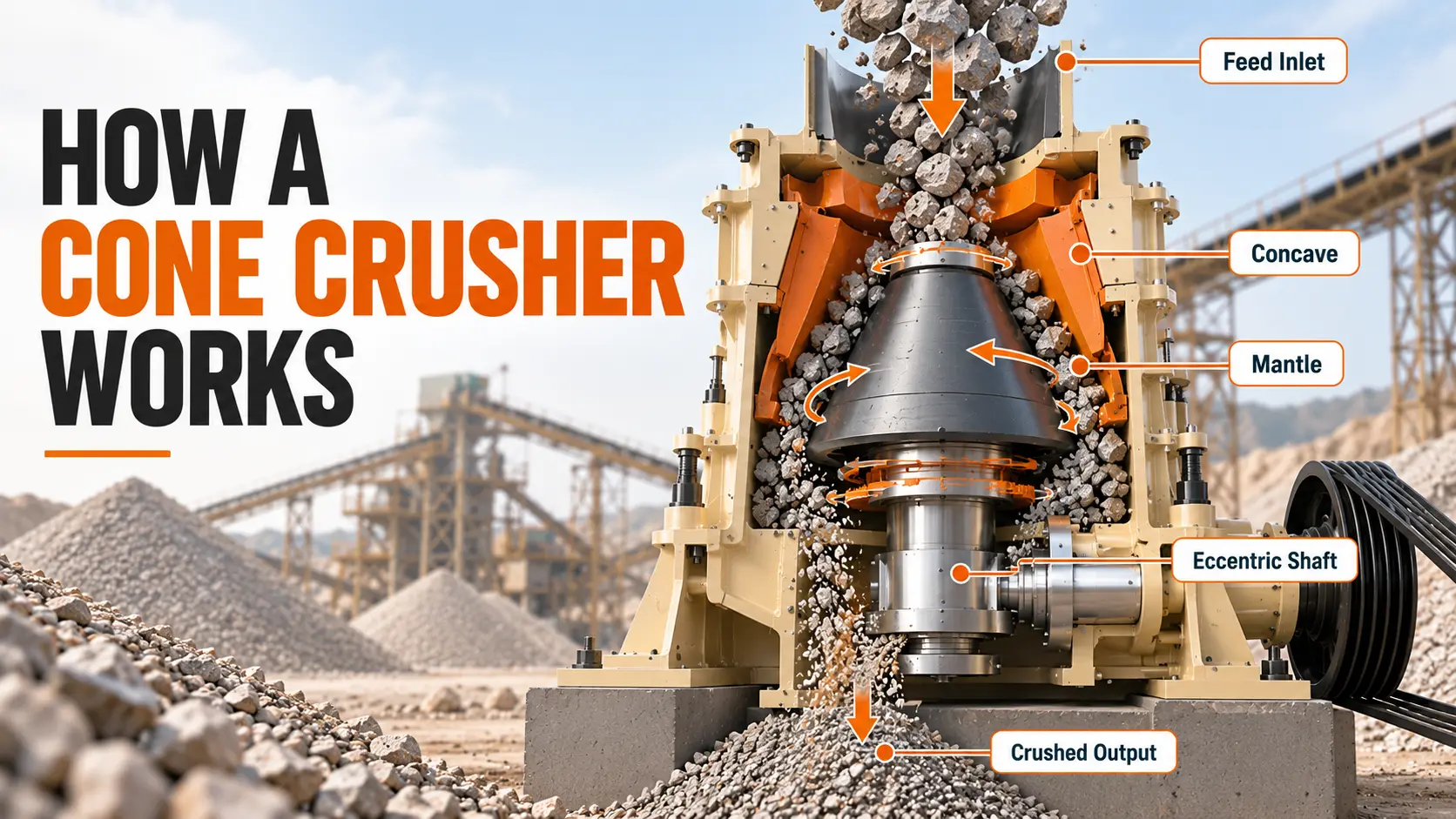
A cone crusher is built for continuous crushing. Instead of a V-shape, the crushing area consists of a spinning inner cone surrounded by a fixed outer bowl.
The main shaft is driven by a motor, causing the inner cone to spin in an off-center circle. As it spins, it constantly moves closer to and further from the outer bowl. When rock drops in, it gets trapped and squeezed. Because the gap is always moving, the rocks also rub against each other, which grinds away the sharp edges.
Pros of a Cone Crusher
- Great Rock Shape: The circular squeezing and rock-on-rock grinding produce the uniform, cube-shaped stones needed for modern construction.
- High Production: Unlike a jaw crusher, a cone crusher crushes rock continuously in a full circle, leading to high production rates.
- Works Best When Full: Cone crushers actually run best when the top is completely buried in rock. This keeps production high and ensures the metal parts wear down evenly.
Cons of a Cone Crusher
- Strict Size Limits: If you put a rock into a cone crusher that is larger than its top opening, it will get stuck and stop your entire plant.
- Complex Maintenance: Cone crushers rely on fast-moving internal parts protected by a constant flow of pressurized oil. Maintaining these systems requires careful attention and skilled workers.
- Dislikes Wet Clay: Cone crushers struggle with wet, sticky dirt. Clay can pack solidly inside the machine, which can push the outer bowl up and damage the internal parts.
Maintenance and Operating Costs
When figuring out the total cost to run your plant, the maintenance needs of these two machines play a big role.
Jaw Crusher Costs
Jaw crushers are cost-effective to run. The main parts that wear out are the metal plates. Because they are easy to reach from the top of the machine, replacing them does not take much time. Also, jaw crushers use standard heavy grease for their moving parts. Daily greasing is a simple, manual task, keeping everyday maintenance cheap and easy.
Cone Crusher Costs
Cone crushers require a larger budget and a strict maintenance routine. The parts that wear out are heavier and require special tools to replace, meaning the machine has to be turned off for longer.
Most importantly, a cone crusher needs a continuous oil system to run safely. You must budget for special oil, filter changes, and regular lab testing for the oil to protect the sensitive internal parts. If a jaw crusher runs low on grease, it might just get warm for a day. If a cone crusher loses oil pressure, the internal parts can be severely damaged in less than a minute, leading to expensive repairs.
Conclusion
If you are setting up a commercial aggregate plant, you do not choose between these machines. You need the strength of the jaw crusher to handle your large raw rocks, and you need the precision of the cone crusher to shape the final product so it can be sold at a good price. Together, they form a complete, effective system.
Frequently Asked Questions
Can a jaw crusher work without a cone crusher?
Yes, but only for basic uses. A jaw crusher by itself is fine if you are producing base gravel for rural dirt roads or general fill material where the exact shape of the rock does not matter to the buyer.
Which is better for hard rock: jaw or cone?
Both are designed for hard rock, but they handle different sizes. A jaw crusher is the right machine for breaking very large, hard boulders. A cone crusher is the right machine for taking those pre-crushed rocks and shaping them into final gravel.
What is the reduction ratio of a jaw crusher vs a cone crusher?
A jaw crusher usually reduces rock by a ratio of 4:1 to 6:1 (for example, breaking a 600mm rock down to 100mm). A cone crusher usually reduces rock by a higher ratio of 5:1 to 8:1, depending on how it is set up.
Are impact crushers better than cone crushers?
Impact crushers break rock very well and are cheaper to buy at first. However, impact crushers wear out very quickly when processing hard, rough rocks. Cone crushers are much more cost-effective over time for harder materials.
What happens if metal accidentally enters these machines?
If a piece of metal (like a tractor tooth) enters a jaw crusher, a safety plate on the back is designed to snap, safely stopping the machine. In a modern cone crusher, a pressure system allows the top bowl to lift slightly, letting the metal pass through safely without bending the main parts.