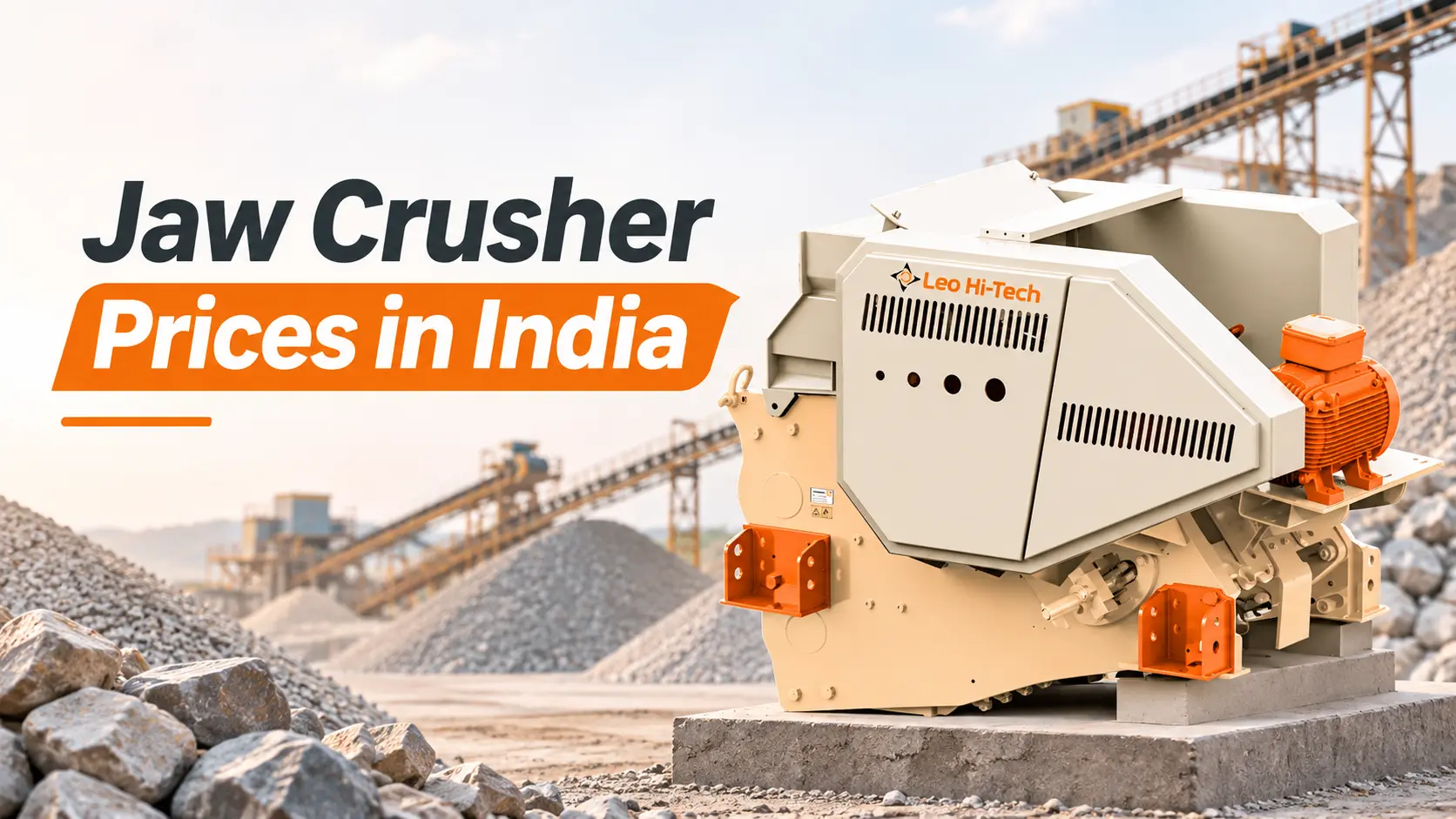
The jaw crusher is usually the first machine you buy for a stone crushing plant, and its price shapes the rest of your budget. Yet the question “what does a jaw crusher cost in India?” rarely gets a straight answer. Prices run from a few lakh rupees for a small unit to tens of lakhs for a large primary crusher, and two machines with the same stated capacity can differ widely in price.
This guide explains typical jaw crusher price ranges in India by capacity, what drives the difference, and how to compare quotations so you pay for performance rather than just tonnes of steel. All figures are indicative market ranges for 2026. Always confirm with a written quotation for your exact model and specification.
How Much Does a Jaw Crusher Cost in India?
The price of a jaw crusher depends mainly on its size and capacity. As a rough guide, a small unit for a mini plant costs far less than a heavy-duty primary crusher built for a highway-scale quarry. The table below shows indicative ranges for the crusher unit.
|
Capacity (TPH) |
Typical Application |
Indicative Price Range |
|
20 – 50 |
Mini plants, small contractors, rural roads |
₹6 – ₹12 lakh |
|
60 |
Small commercial aggregate plants |
₹12 – ₹18 lakh |
|
100 |
Mid-sized commercial plants |
₹18 – ₹28 lakh |
|
150 – 200 |
Large commercial and highway projects |
₹30 – ₹50 lakh |
|
250 – 400 |
Quarry-scale primary crushing |
₹50 – ₹90 lakh and above |
These ranges are for the crusher itself. GST, freight, foundation work, feeders, conveyors, and electricals are usually extra, so check exactly what each quotation includes. Capacity figures also depend on rock type and discharge setting, so treat TPH as a range, not a promise.
What Decides the Price of a Jaw Crusher?
Two crushers with the same feed opening can be priced very differently. These are the main factors:
- Size and capacity: a larger feed opening needs a heavier frame, flywheels, and a bigger motor, which raises cost.
- Frame construction: bolted, non-welded frames resist fatigue and vibration better than welded frames, and they cost more to build.
- Casting and bearing quality: the pitman, swing jaw, toggle plate, and bearings carry the crushing load. Premium castings and branded bearings add to the price but extend life.
- Jaw plate material: manganese steel grade affects wear life on abrasive rock such as granite and basalt.
- Setting adjustment system: wedge or hydraulic adjustment makes CSS changes quicker and safer, but hydraulic systems add cost.
- Motor, drive, and mounts: motor power, belt drive, guards, and an in-built motor mount all change the quote.
- Brand and after-sales support: a manufacturer that stocks spares and sends service engineers charges for that reliability, and it is usually worth it.
Choosing the Right Size: Feed Opening and Capacity
Jaw crushers are named by their feed opening, for example 900 × 600 mm. As a rule of thumb, the largest boulder you feed should be no more than about 80% of the opening width, otherwise it will bridge across the jaws and block the crusher.
Capacity also depends on the closed side setting (CSS). A tighter CSS gives a smaller product but lowers throughput. For example, Leo’s LJ series runs from the LJ 100 (800 × 510 mm opening, 75 kW motor) to the LJ 550 (1400 × 1200 mm opening, 200 kW motor). At a 100 mm CSS, the LJ 100 handles roughly 140–190 TPH, the LJ 200 about 205–265 TPH, and the LJ 450 about 270–369 TPH.
The lesson is to ask suppliers for capacity at your CSS and your rock type, not a headline TPH figure. Our guide on what TPH means in a crusher machine explains how to read these numbers.
Price per TPH: Why Bigger Machines Cost Less per Tonne
Comparing price per unit of capacity shows an important pattern. Using the indicative ranges above, a 60 TPH jaw crusher works out to roughly ₹20,000–30,000 per TPH, a 100 TPH machine to about ₹18,000–28,000 per TPH, and a 200 TPH machine to about ₹15,000–25,000 per TPH. Larger crushers generally cost less for each tonne of hourly capacity.
That does not mean you should buy the biggest machine. An oversized crusher running half empty wastes power, wears unevenly, and ties up capital. Size the crusher to your real feed rate and the largest boulder you will receive, and leave sensible headroom of around 20–30% for growth.
Single Toggle vs Double Toggle: Does It Affect Price?
Most modern jaw crushers sold in India for aggregate work are single-toggle designs. They are lighter, have a more aggressive crushing motion, and generally deliver higher capacity for their size. Double-toggle machines are heavier and more complex, and they are chosen for specific hard or abrasive duties. In general, expect to pay more for a double-toggle machine of the same opening, so match the design to your rock instead of paying for features you will not use.
New vs Used Jaw Crushers
A second-hand jaw crusher can look like a bargain, but weigh the trade-offs:
- Pros: lower upfront cost and quicker delivery from local stock.
- Cons: unknown load history, worn pitman bearings or shafts, no warranty, difficult spare parts for old or obscure models, and often lower capacity than advertised.
- Middle path: buy from a manufacturer that offers reconditioned machines with a written warranty and inspection report.
For a plant that will run daily shifts for years, a new crusher with proper support usually has the lower cost per tonne.
Costs Beyond the Purchase Price
The sticker price is only part of what a jaw crusher costs you. Budget for these as well:
- Wear parts: jaw plates and cheek plates need regular replacement, and their life depends on the rock.
- Power: a 75 kW motor at full load on ₹8 per kWh grid power costs about ₹600 an hour to run.
- Foundation and installation: reinforced concrete foundations, anchor bolts, and commissioning.
- Feeder and conveyors: the crusher needs a grizzly feeder ahead of it and a conveyor beneath it.
- Downtime: a cheap machine that stops often costs more than a reliable one that does not.
How to Compare Jaw Crusher Quotations
- Fix the specification first. Give every supplier the same rock type, feed size, target product, and TPH at your CSS.
- Compare what is included. Check motor, drive, guards, motor mount, lubrication, and the first set of jaw plates.
- Ask about materials. Request manganese grade for jaw plates and details of the castings and bearings.
- Check the frame. Ask whether it is bolted or welded and how it is anchored.
- Confirm spares and service. Ask about stock of wear parts, delivery times, and field engineers.
- Visit a running plant. A reference visit tells you more than any brochure.
Jaw Crusher or Another Primary Crusher?
For hard, abrasive rock such as granite and basalt, a jaw crusher is the standard primary machine because it handles large boulders and is simple to maintain. Roller crushers and impact crushers suit softer, less abrasive material. If you are unsure how a jaw crusher compares with a cone crusher, which works at the secondary stage, read our comparison of jaw crusher vs cone crusher before you finalise your plant layout.
Where the Jaw Crusher Fits in Your Plant Budget
Remember that the jaw crusher is one part of a full plant. For a 100–200 TPH stone crusher plant, total machinery typically costs ₹80 lakh to ₹2.5 crore, and land, civil works, licensing, and power add more. Read our complete breakdown in The Cost of a Stone Crusher Plant in India to see how the jaw crusher price fits into the whole investment.
Conclusion
A jaw crusher in India can cost anywhere from a few lakh rupees to ₹90 lakh or more, depending on capacity, build quality, and support. Indicative prices are about ₹18–28 lakh for 100 TPH and ₹30–50 lakh for 150–200 TPH. Compare quotations on the same specification, look at lifetime costs rather than only the purchase price, and choose a manufacturer who stands behind the machine.
Frequently Asked Questions
What is the price of a 100 TPH jaw crusher in India?
Indicatively, about ₹18–28 lakh for the crusher unit, depending on size, frame construction, and components. GST, freight, and installation are extra.
Which jaw crusher size is best for a small plant?
For a plant of around 50–100 TPH, a mid-sized opening that comfortably takes your largest boulder is usually right. Choose by feed size and CSS, not only by TPH.
How often do jaw plates need replacement?
It depends on rock abrasiveness, feed control, and plate material. Track tonnes crushed per set so you can plan replacements and compare suppliers.
Is a jaw crusher enough for a complete plant?
A jaw crusher handles primary crushing only. Most plants add a cone crusher or impact crusher, vibrating screens, and conveyors to produce finished aggregates.